Feeds:
Posts
Comments

Archive for the ‘09 Map Symbolization’ Category

Seventeen variations on a theme:

Symbols for…

Normal or broad gauge, single track railroad, operating.
Normal or broad gauge, single track railroad, non-operating.
Normal or broad gauge, double or multiple track railroad, operating.
Normal or broad gauge, double or multiple track railroad, non-operating.
Narrow gauge, single track railroad, operating.
Narrow gauge, single track railroad, non-operating.
Narrow gauge, double or multiple track railroad, operating.
Narrow gauge, double or multiple track railroad, non-operating.
Railroads in juxtaposition.
Railroad yards.
Railroad station.
Point of change in gauge, number of tracks, or in the reliability of the elignment or the existence of railroad.
Railroad, location approximate.
Railroad, exact location unknown.
Aerial cableway, ski lift, conveyor belt and similar features.
Railroad names (Principal railroads only).
Railroads in outlined populated places.

Symbol and drafting specifications:

Symbol and specifications for (hand) compilation and (ink) drafting:

Symbols for Small Scale Maps
Corps of Engineers, U.S. Army
Army Map Service
Washington DC
1953

Read Full Post »

To understand map design, and how maps work, it is useful to see how map design concepts play out on a real map.

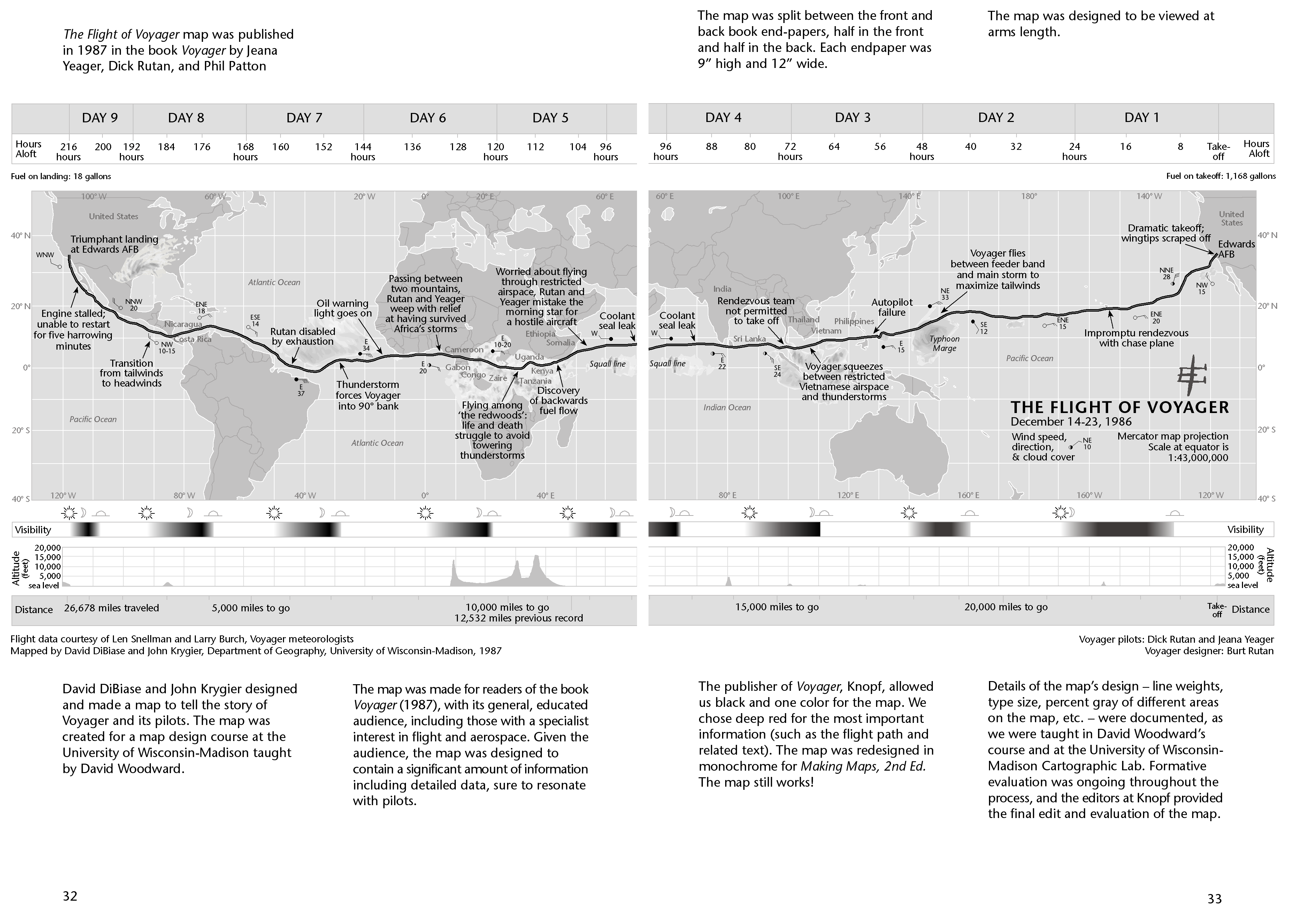
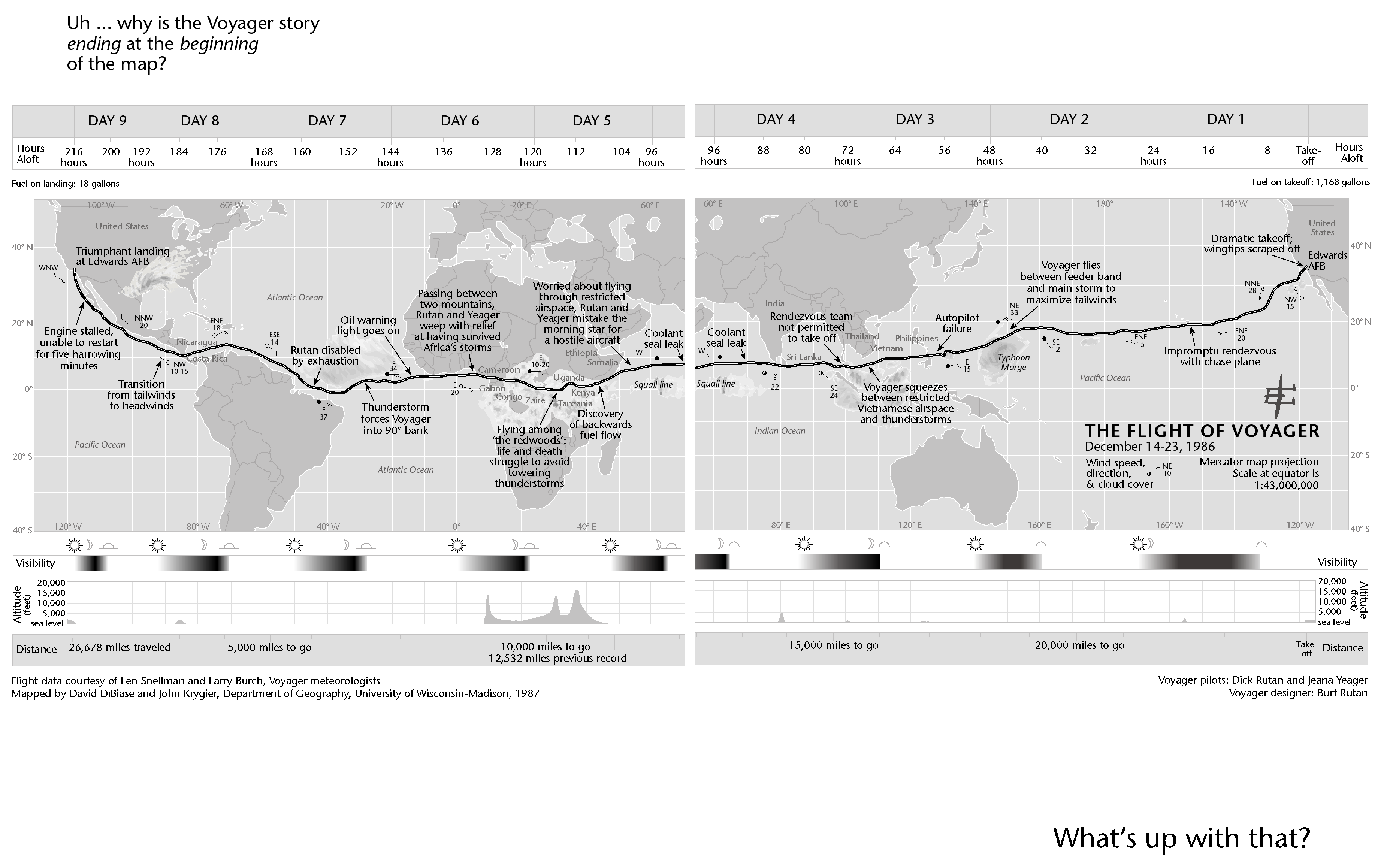
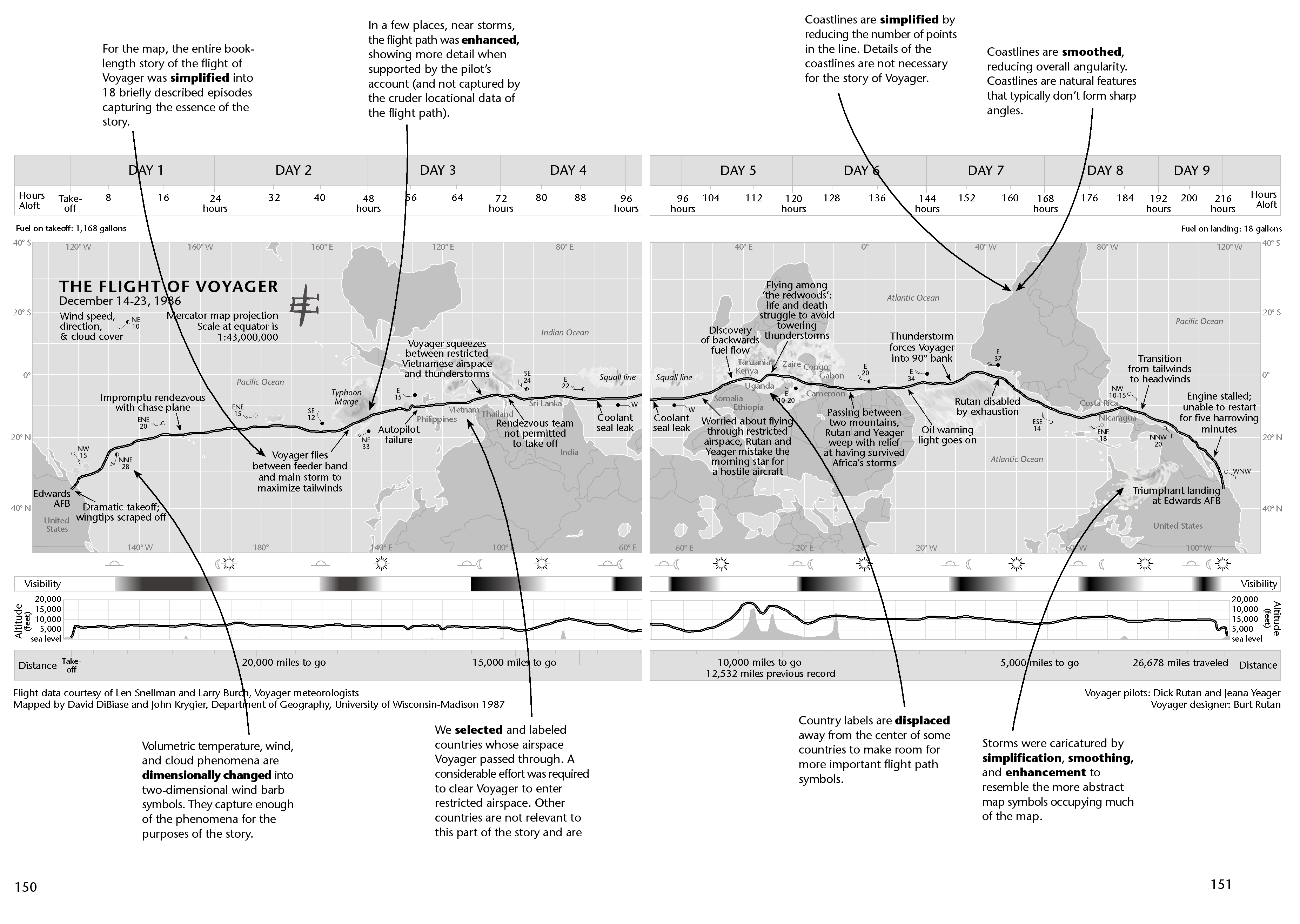
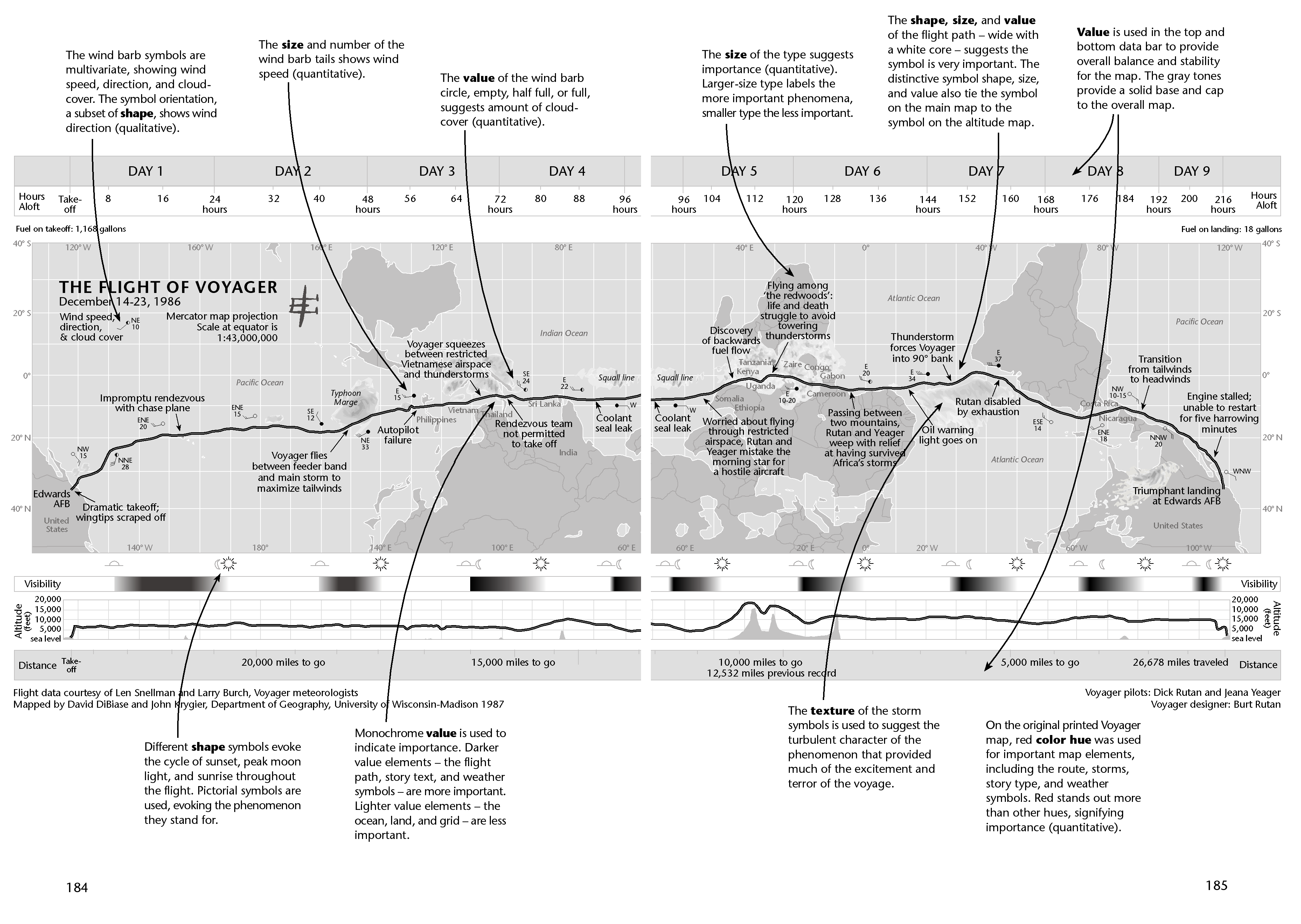
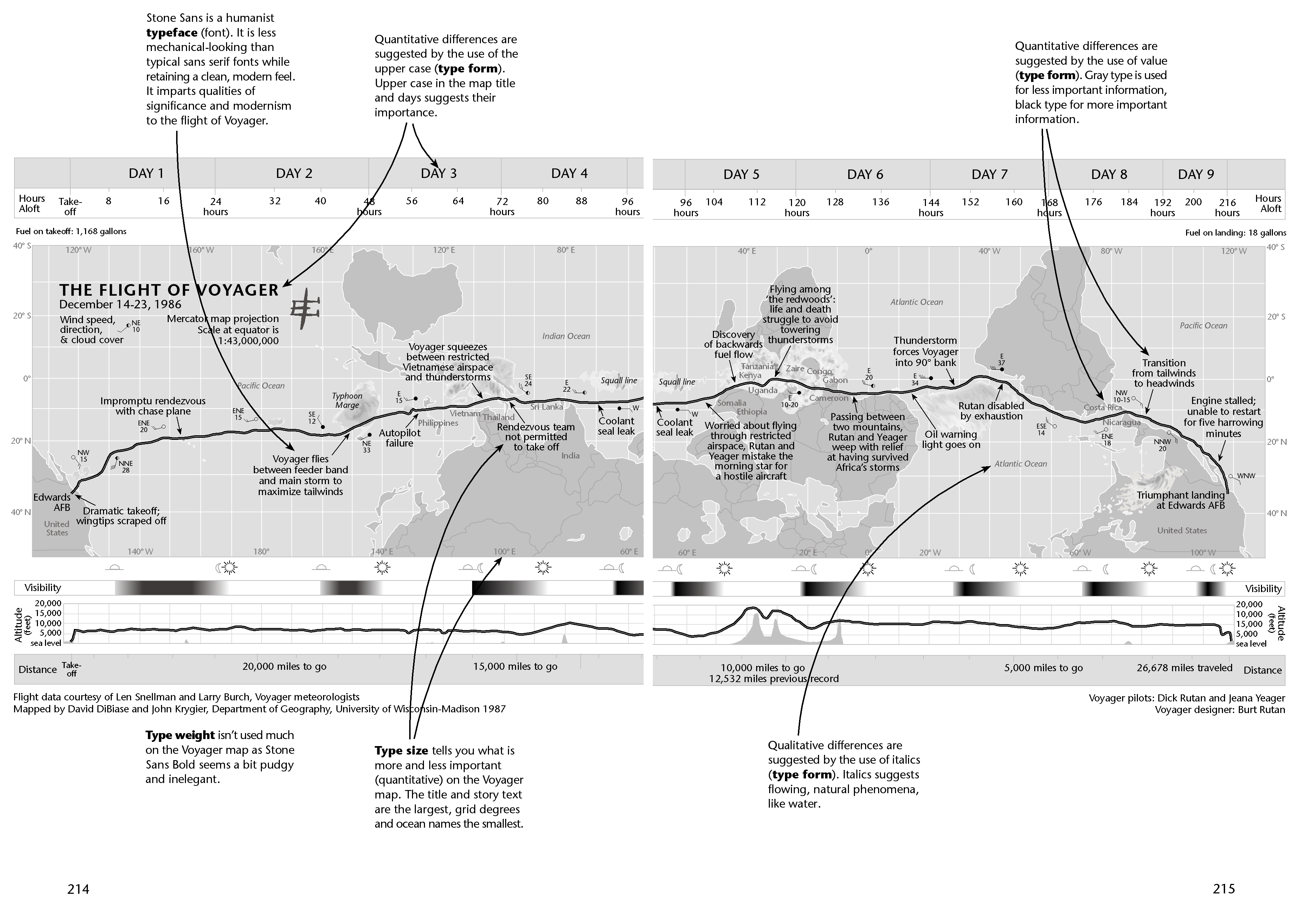
One of the significant updates to the 2nd edition of Making Maps was the inclusion of a map of the 1986 trans-global flight of the experimental aircraft called Voyager. This map, originally designed and created by David DiBiase and I back in 1987 for David Woodward’s map design course (and in the University of Wisconsin Cartographic Lab), is repeated thirteen times in seven of the chapters, annotated to show how the concepts and ideas in these chapters play out on the map.

The repeatedly annotated Voyager map serves as an example of map design in practice, but also a guide to “reading” a map from the perspective of map design.

Martin Dodge suggested the annotated maps be available together, for instructional purposes. A good idea! So here they are. Each individual map on this page is a 800k PNG file (click for full size).

A PDF file (8.8mb) with all thirteen higher resolution TIFF images is available here.

The Voyager map project was quite a bit of fun to create back in the day. It won a map design award, was published in the book about the Voyager flight, and printed on paper as part of a promotion for the Waukesha County, Wisconsin Airport. I cannot imagine anything much more exciting than that.

••••••••••

The second map in the series prefaces the initial chapter in Making Maps 2nd edition, and poses a series of questions that will be addressed in future chapters (and annotated Voyager maps):

Chapter 2, What’s Your Map For?, sets the context of the map (and of its re-creation for the book) and how such context shapes the design of the map:

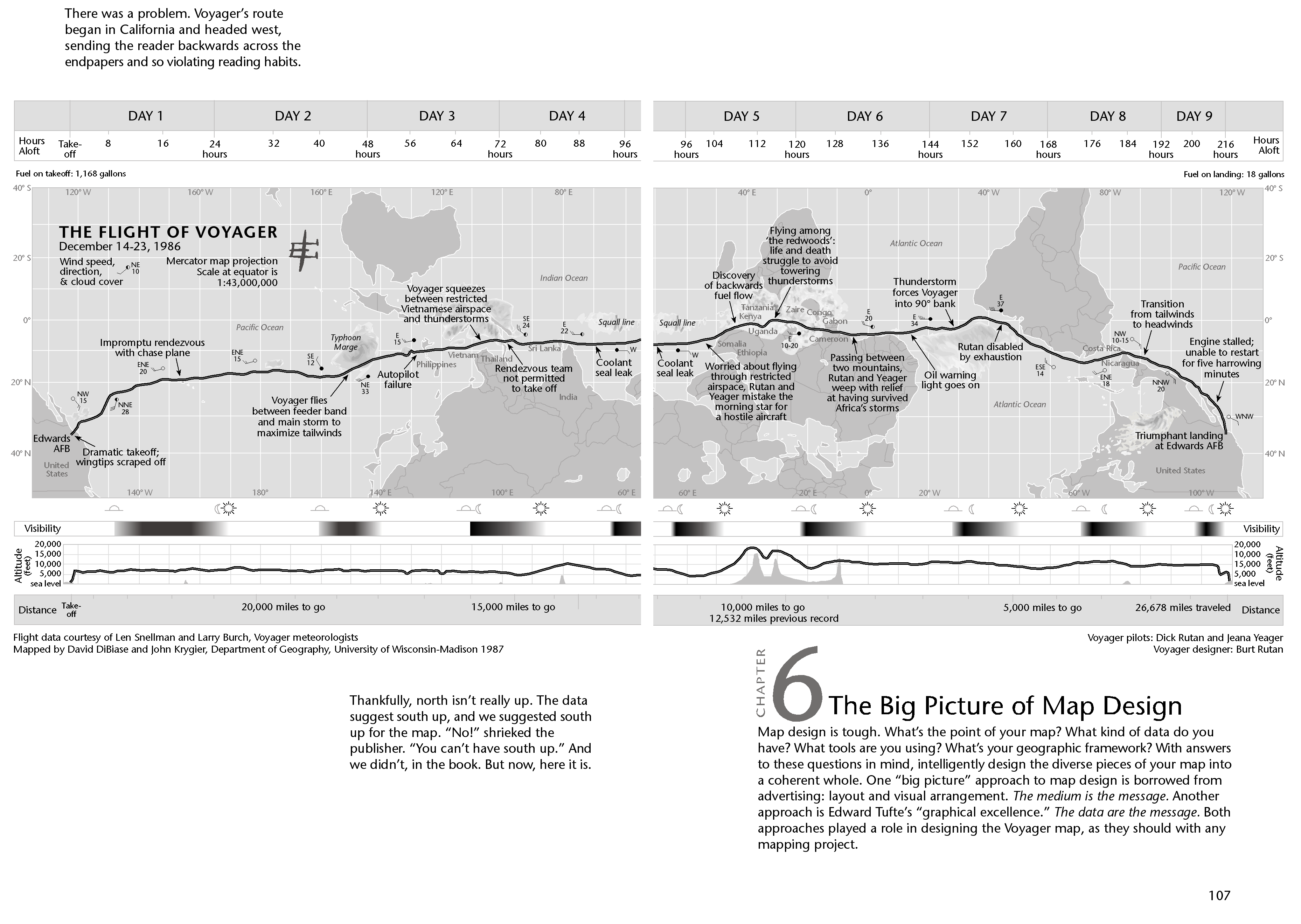
Chapter 6, The Big Picture of Map Design, repeats the Voyager map five times, focusing on the key map design concepts covered in the chapter. This is where the map flips orientation south up (a controversial design choice, according to some reviewers: good! Think about why such a choice is controversial, and if it should be [or ask your students to do so]):

South is now up (so the story reads from left to right):


Annotations about map pieces including title, scale, explanatory text, legend, directional indicator, border, sources, credits, and insets & locator maps:

Annotations about visual arrangement including path, visual center, balance, symmetry, sight-lines, and grids:

Annotations about graphical excellence, based on Edward Tufte’s ideas, including complexity, detail, design variation & data variation, context, revision, non-data ink, data-ink ratio, explanatory text, editing, chartjunk & map crap, redundancy, and multivariate data:

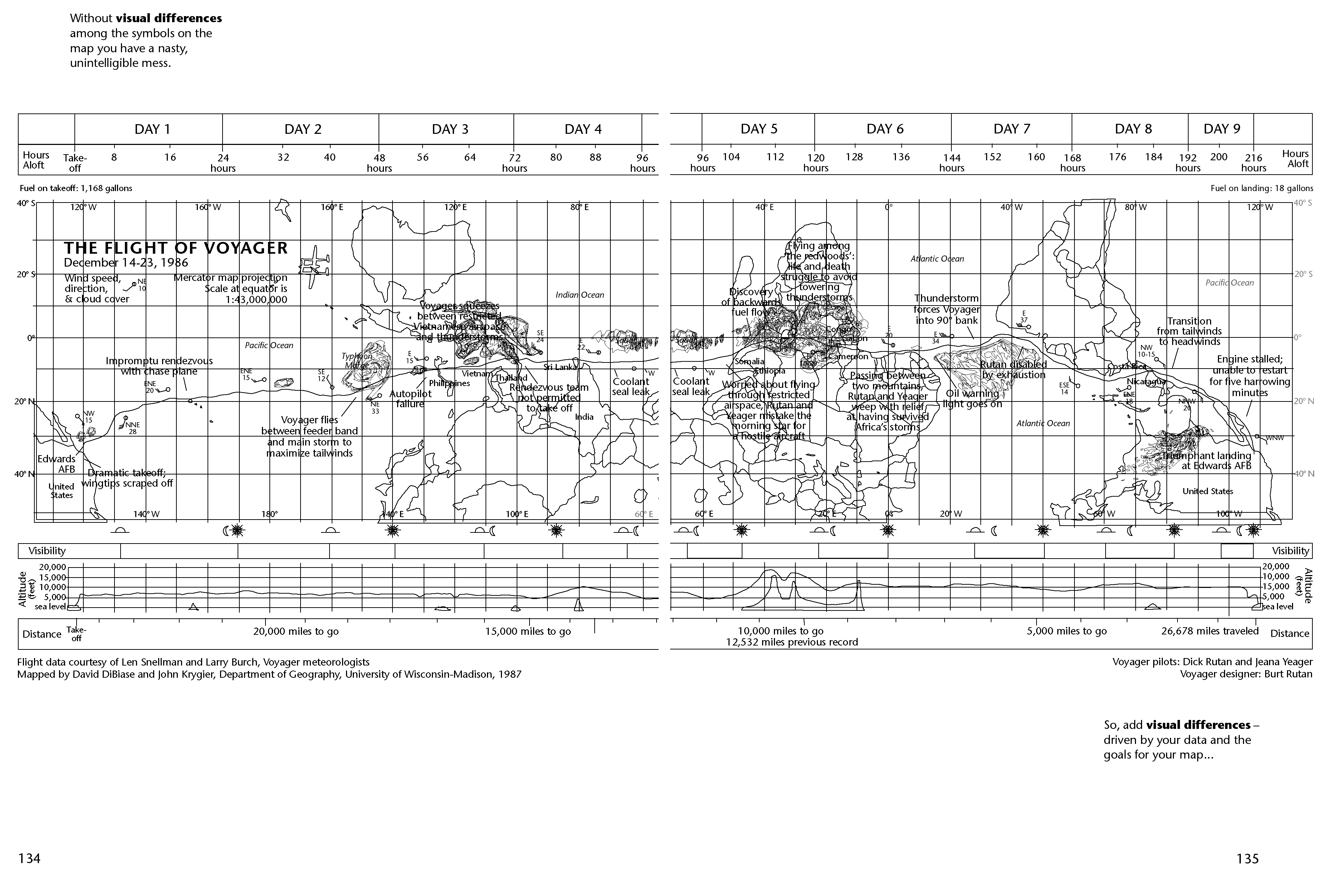
Chapter 7, The Inner Workings of Map Design, reveals the Voyager map with no visual differences (a confusing mess of lines and type):

The map with visual differences is then annotated, with regard to key methods for establishing visual differences, including detail, edges, texture, layering, shape, size, closure, proximity, simplicity, direction, familiarity, and color:

Chapter 8, Map Generalization and Classification, annotates the Voyager map in terms of the generalization concepts of selection, dimension change, simplification, smoothing, displacement, and enhancement:

Chapter 9, Map Symbolization, annotates the map in terms of the visual variables: shape, size, color hue, color value, color intensity, and texture:

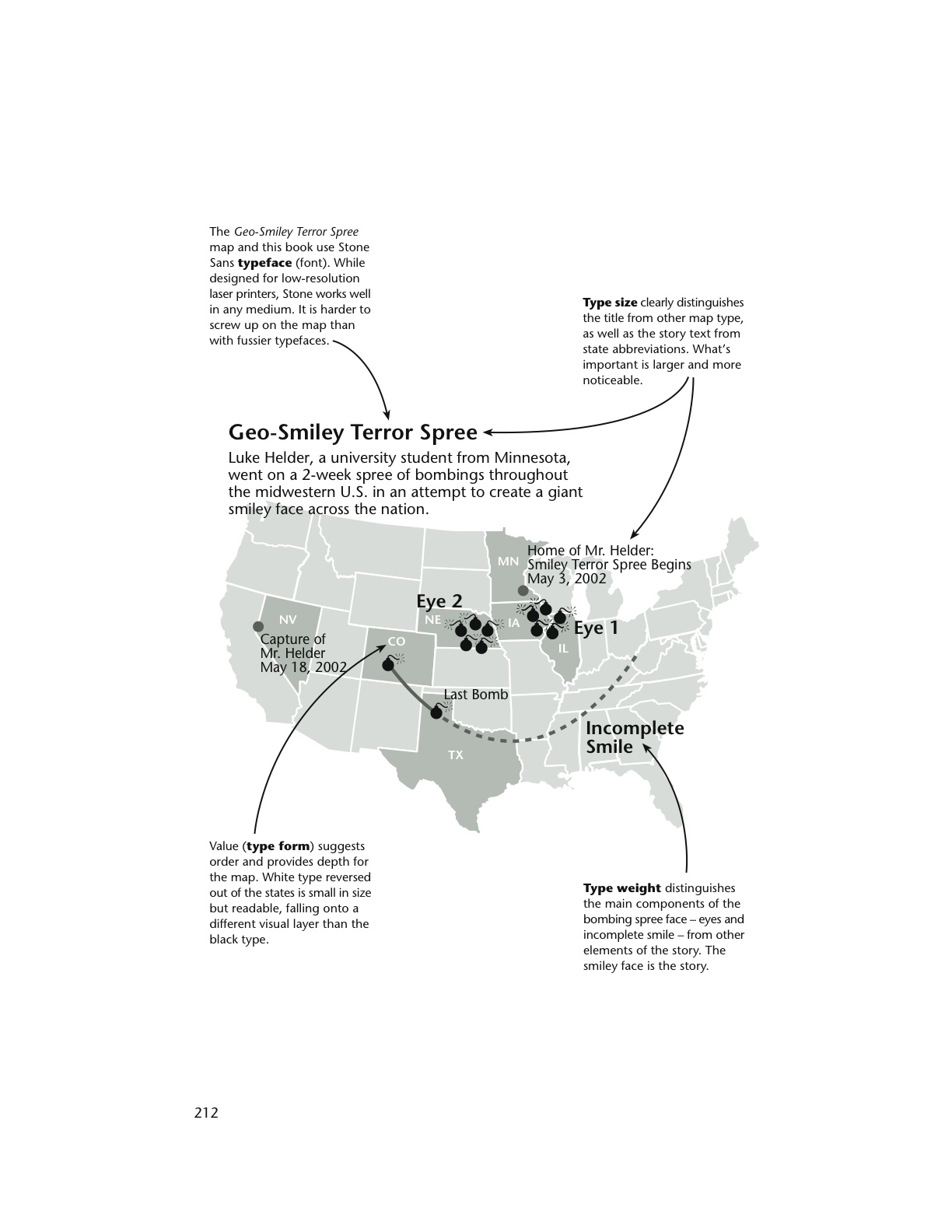
Chapter 10, Words on Maps, annotates the Voyager map with regards to typographic variables including typeface, type form, type weight, and type size:

I have a few ideas for additional annotated Voyager maps (such as a full color map) which I hope to cobble together in the future. If you have any other ideas for variations that might be useful or interesting, let me know.

Read Full Post »

Concerns about the failing nuclear reactors in Japan and the fear of spreading radiation inspired me to share one of my favorite maps. The map shows areas in the United States crossed by two or more radioactive clouds during the era of nuclear testing (1951-1962) in the American Southwest. Click on the map for a larger version.

Richard Miller painstakingly created his map showing where humans, animals, and the environment were contaminated by radioactive fallout, broadly dispersed by weather patterns.

A sublime map, both beautiful and terrifying.

The map is also reproduced in my forthcoming book, Making Maps, 2nd Edition (due any day now).

Source: Richard Miller, “Areas crossed by two or more radioactive clouds during the era of nuclear testing in the American Southwest, 1951-62” in Under the Cloud: The Decades of Nuclear Testing (Two-Sixty Press, 1999), between chapters 4 and 5.

Read Full Post »
Click map for larger version; full version (7.3 mb PDF) here

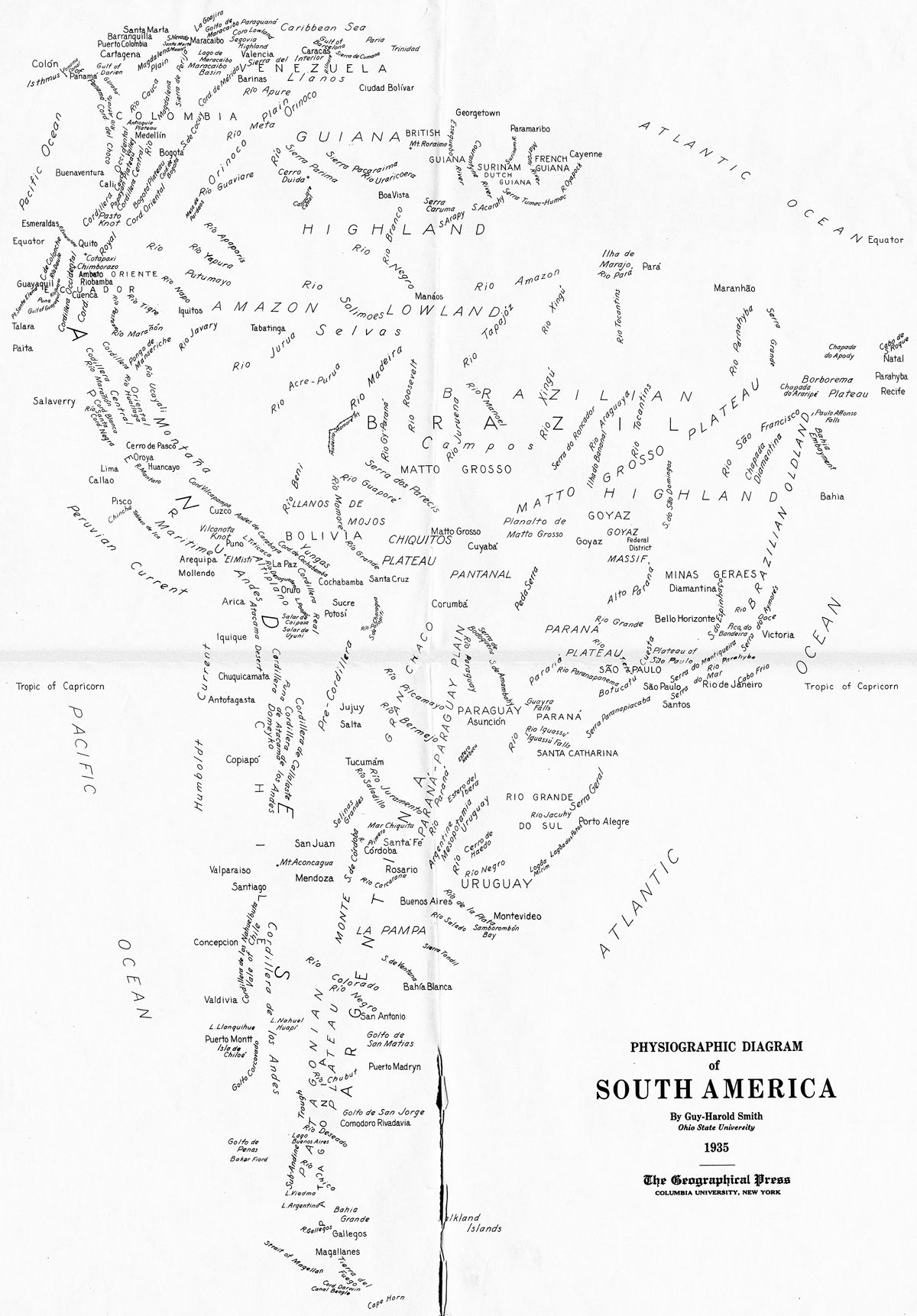
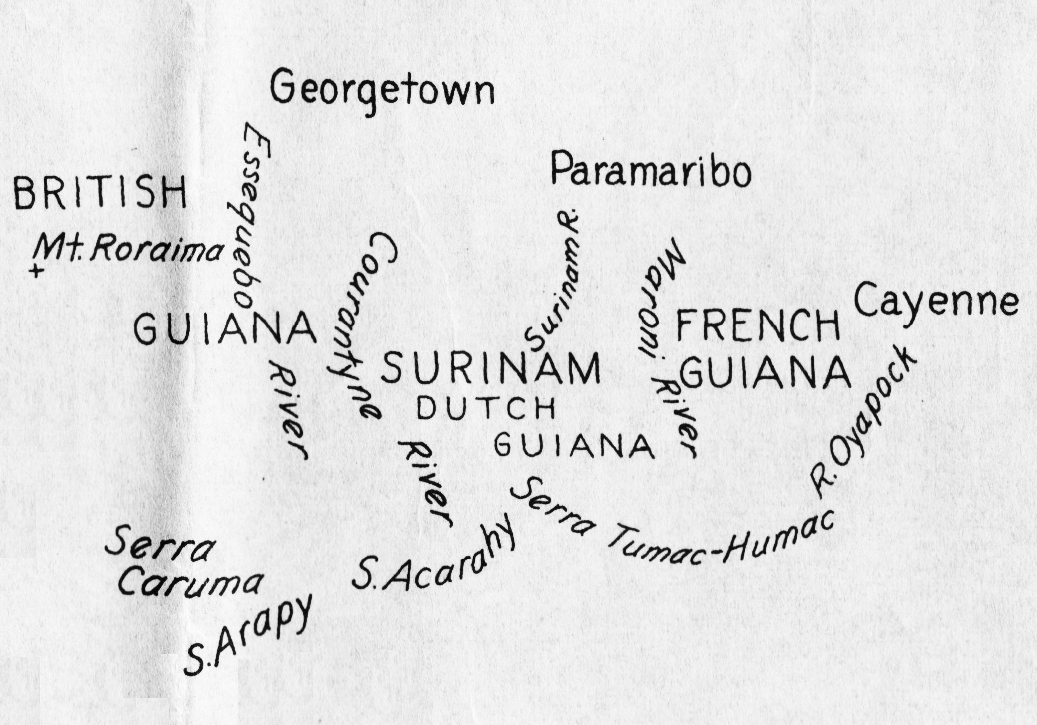
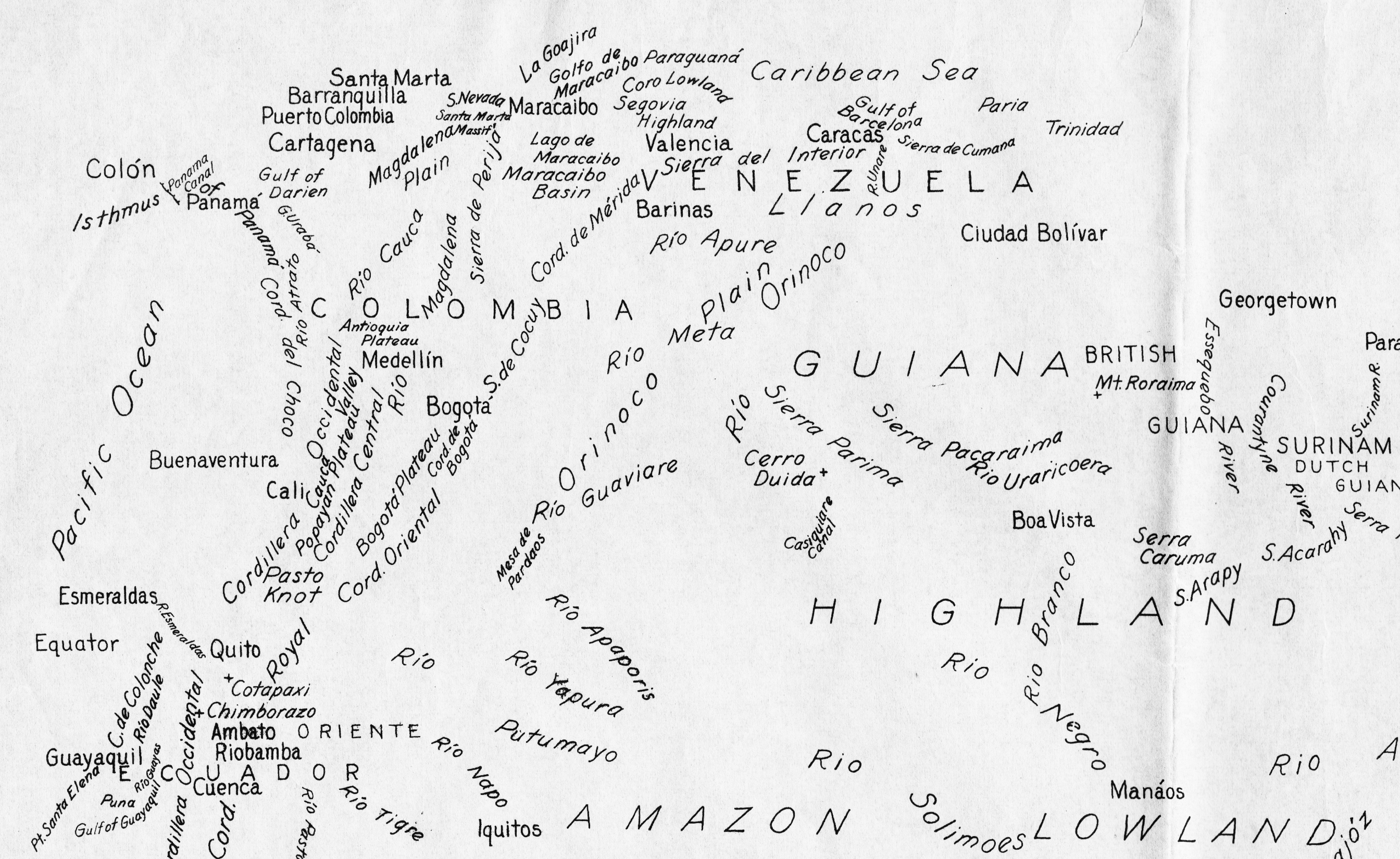
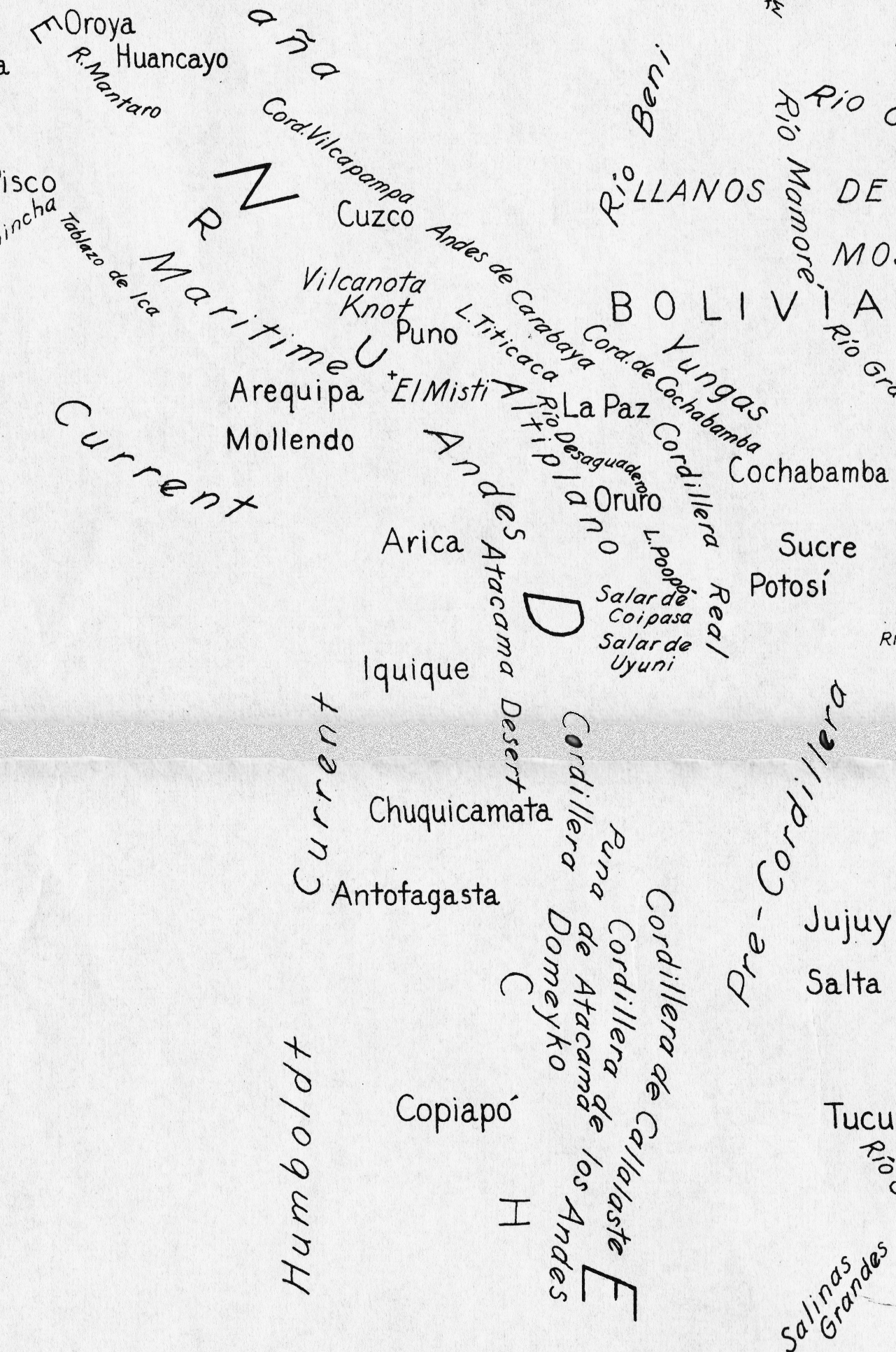
The beauty of words on maps is often not evident, embedded, as they are, in an array of other symbols. A “word map” of South America (above), published by the Geographical Press in 1935, consists entirely of hand-lettered words. The map is supposed to show the labeled landforms of South America; this copy was erroneously printed without the landforms. The map is another find from the dusty old Departmental archives here at Ohio Wesleyan.

The South America word map is not that dissimilar from the word map poetry of Howard Horowitz: below, Manhattan:

A few examples of “word maps” or “typographic maps” have recently popped up on the internets.

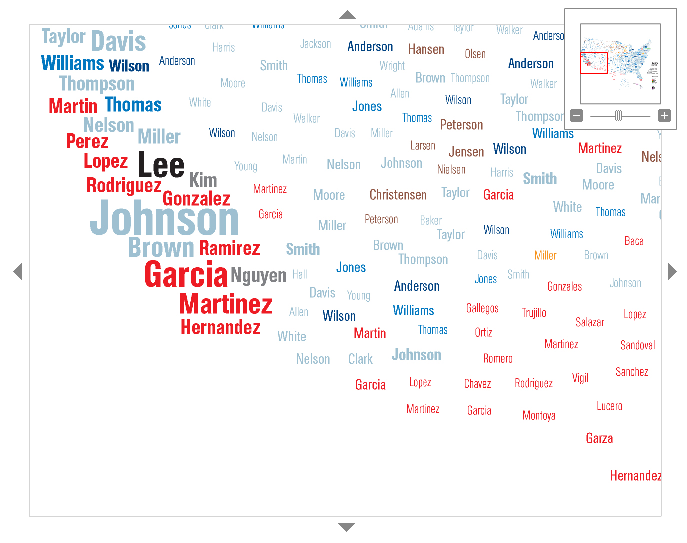
National Geographic’s What’s in a Surname (below) interactive map of the dominant surnames in different parts of the US (upper Midwest, and Southwest) reveal structure (the form of the US is evident) as well as meaning (variations in ethnicity across the US).

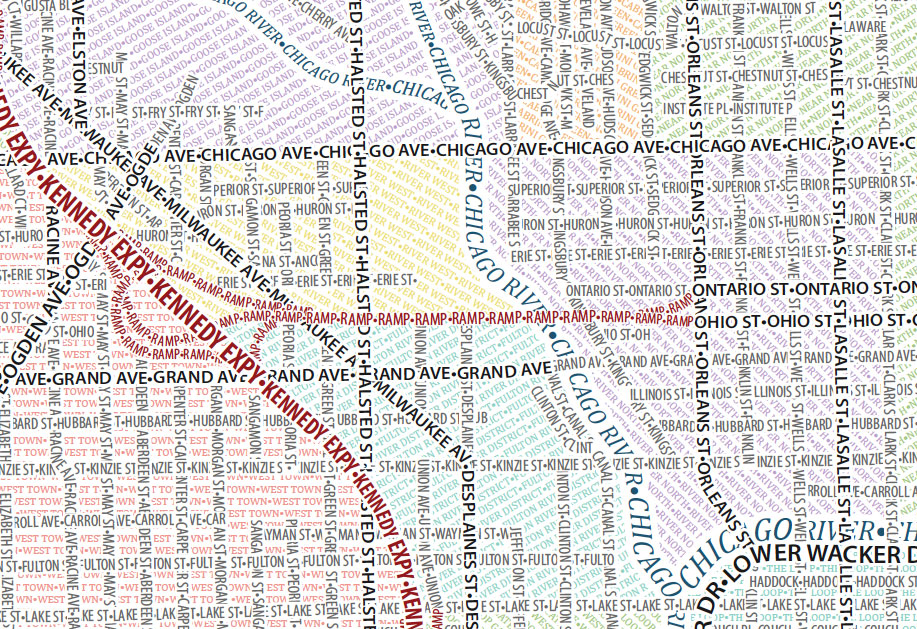
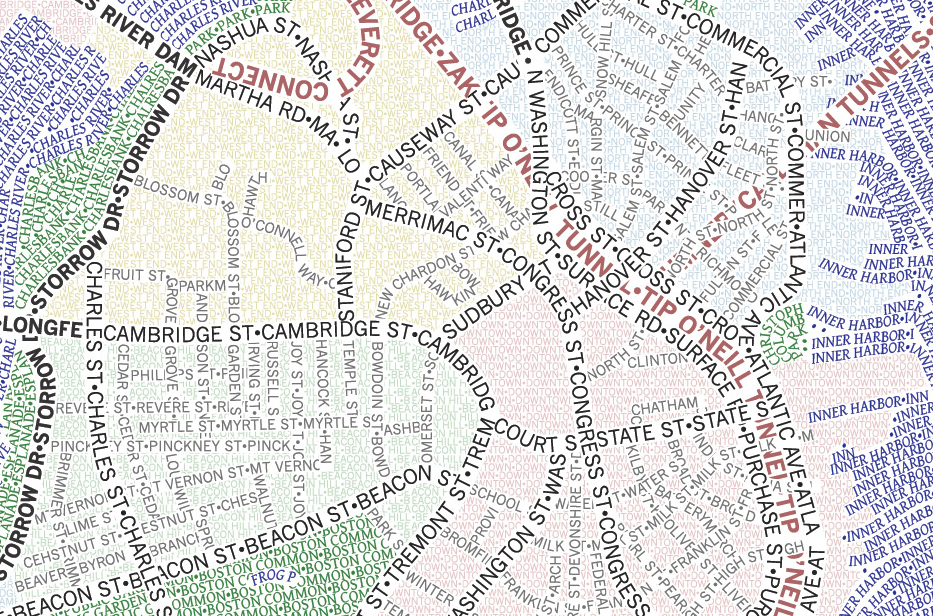
Axis Maps Typographic Map series works in much the same way, but at a different scale and in a bit more complex manner:

Chicago Typographic Map (Axis Maps)


Boston Typographic Map (Axis Maps)

The Axis Typographic Maps use typography as line and area map symbols, providing a nuanced exposition of the geography of these places, the grid of Chicago or the meandering roads of Boston. Again, both meaning and structure are generated by words alone.

But back to the old South America map…

The South American map follows the typical “rules” about type placement, worked out in practice throughout the last few hundred years, and now embedded in cartography texts and in automatic text placement algorithms in GIS software. These rules will, in most cases, make the map easier to read and understand. On the excerpts of the South America map below

  • City names are mixed caps/lower case, roman, and horizontal
  • Country names are upper case, horizontal, and spread out to define the areas
  • Natural features are in the more flowing italics form; if referring to a point, they are horizontal, if they refer to linear or area features (rivers, regions) they are curved to fit the feature.

In practice, placement is complicated, as words cross other words, wrap around each other, and (on most maps) vie for space with other map symbols. The South America map has some neat examples of the art of placing words on maps:

The size of the words varies – suggesting large areas, or places of more importance.

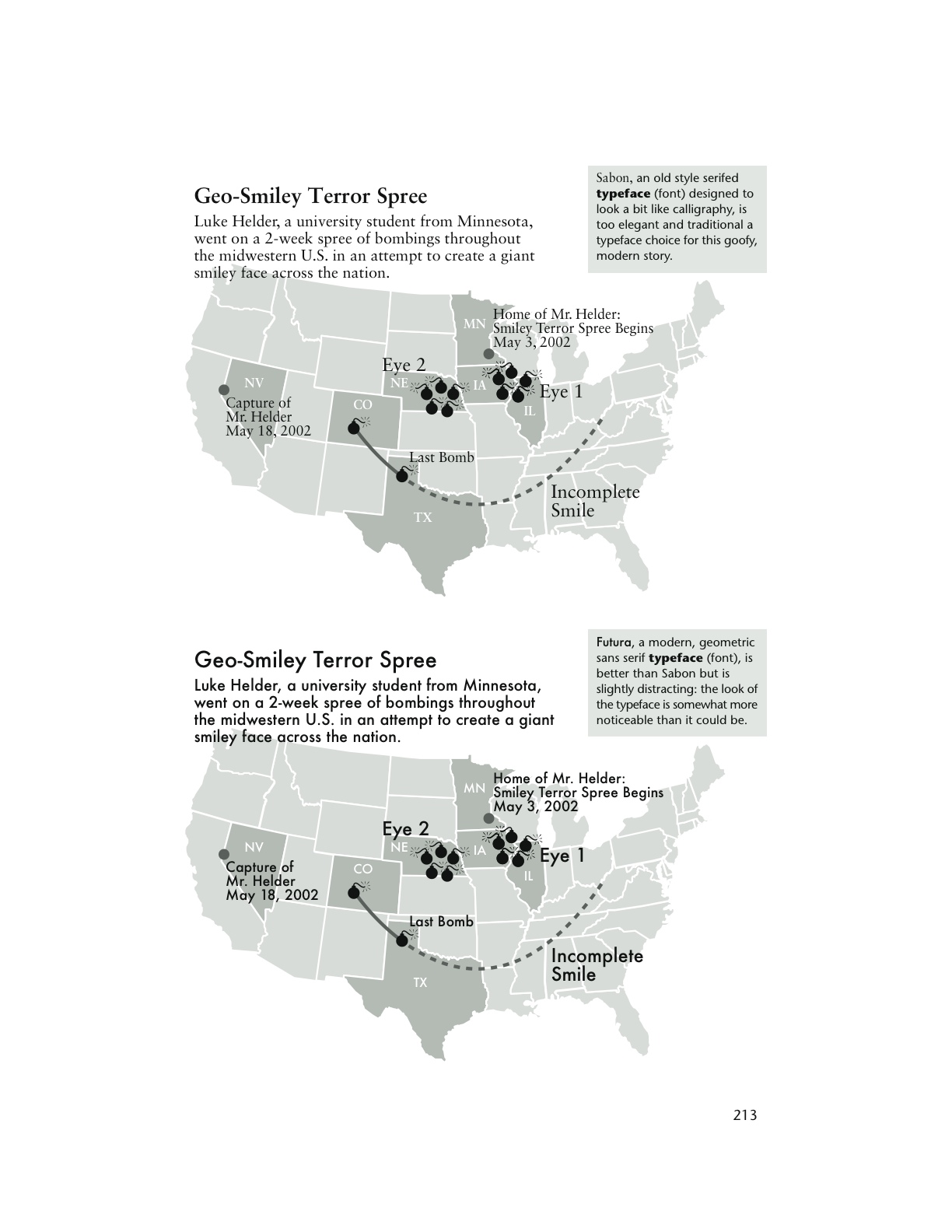
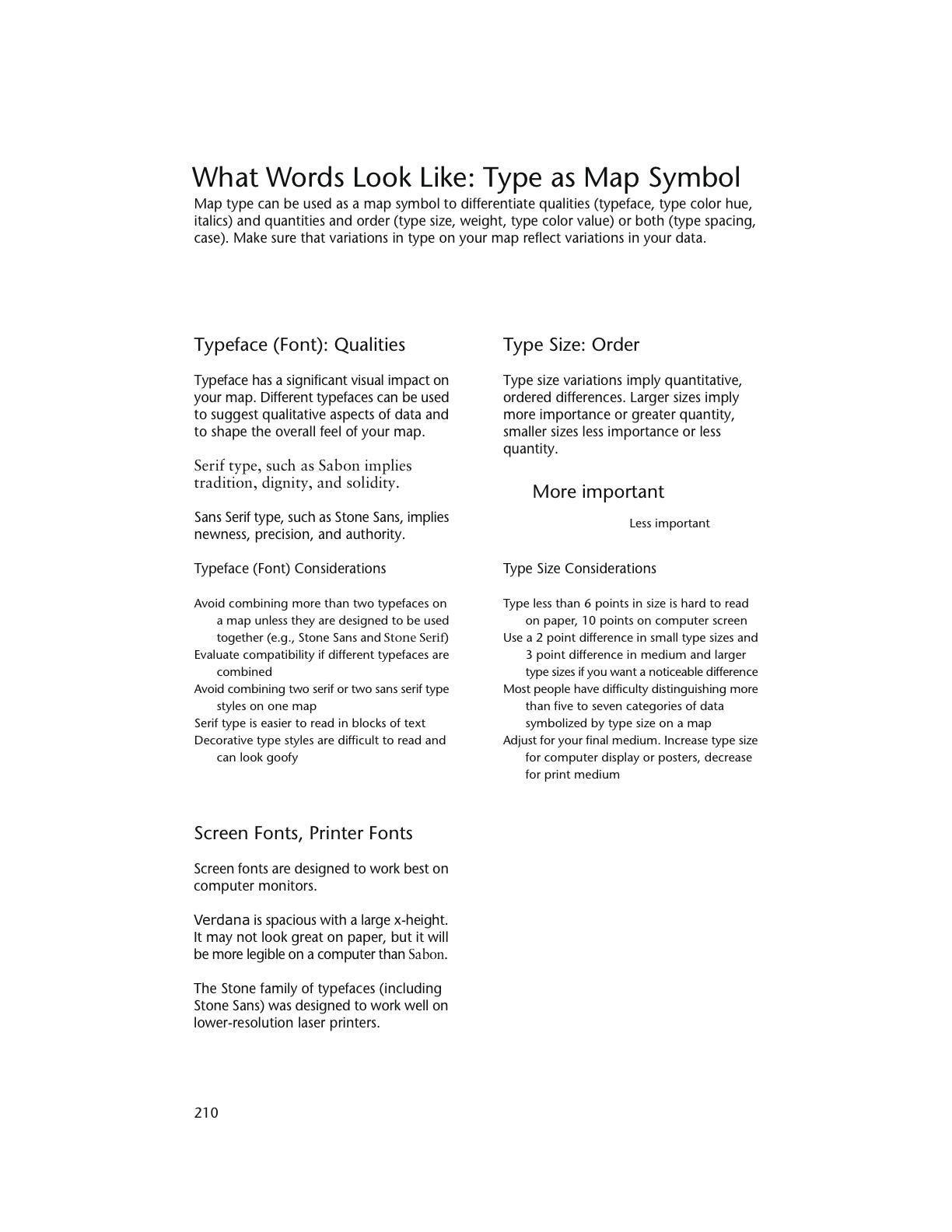
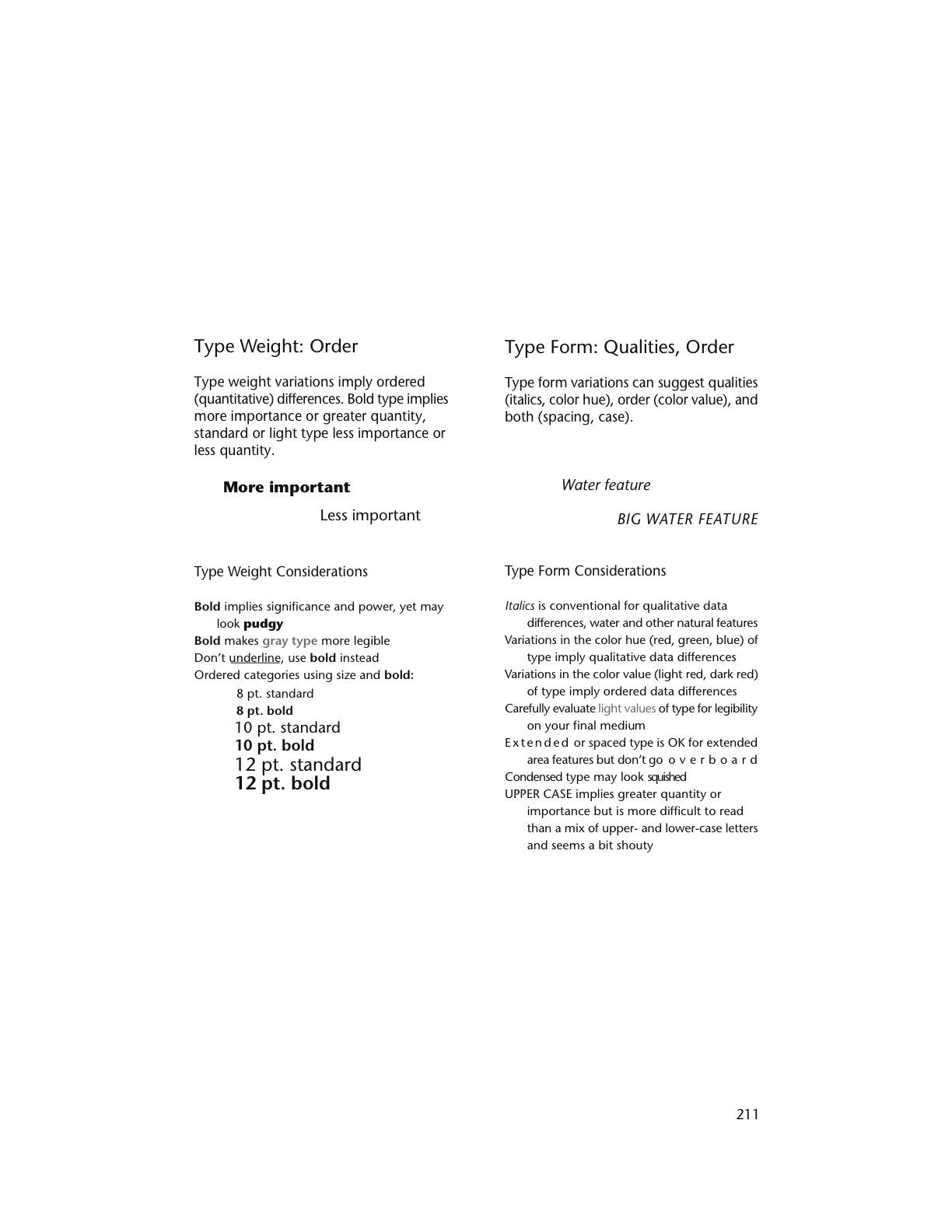
Below find a few pages from the new (2nd) edition of Making Maps (2011) on type as a map symbol. These pages show how typography can be used to express both qualitative and quantitative characteristics of the data they stand for on a map. Typographic guidelines on these pages include typeface (font), type size, type weight, and form (including italics, roman, color, case, and spacing).

Read Full Post »
Francois de Dainville, in his Le Language des Geographes (1964, p. 162), compiled map symbols for various water crossings from historical European maps (1543-1777).

The symbols include boats (Bac, above), fords (Gué, below)…

…and bridges (Pont, below).

The entire set of symbols in one image:

Read Full Post »
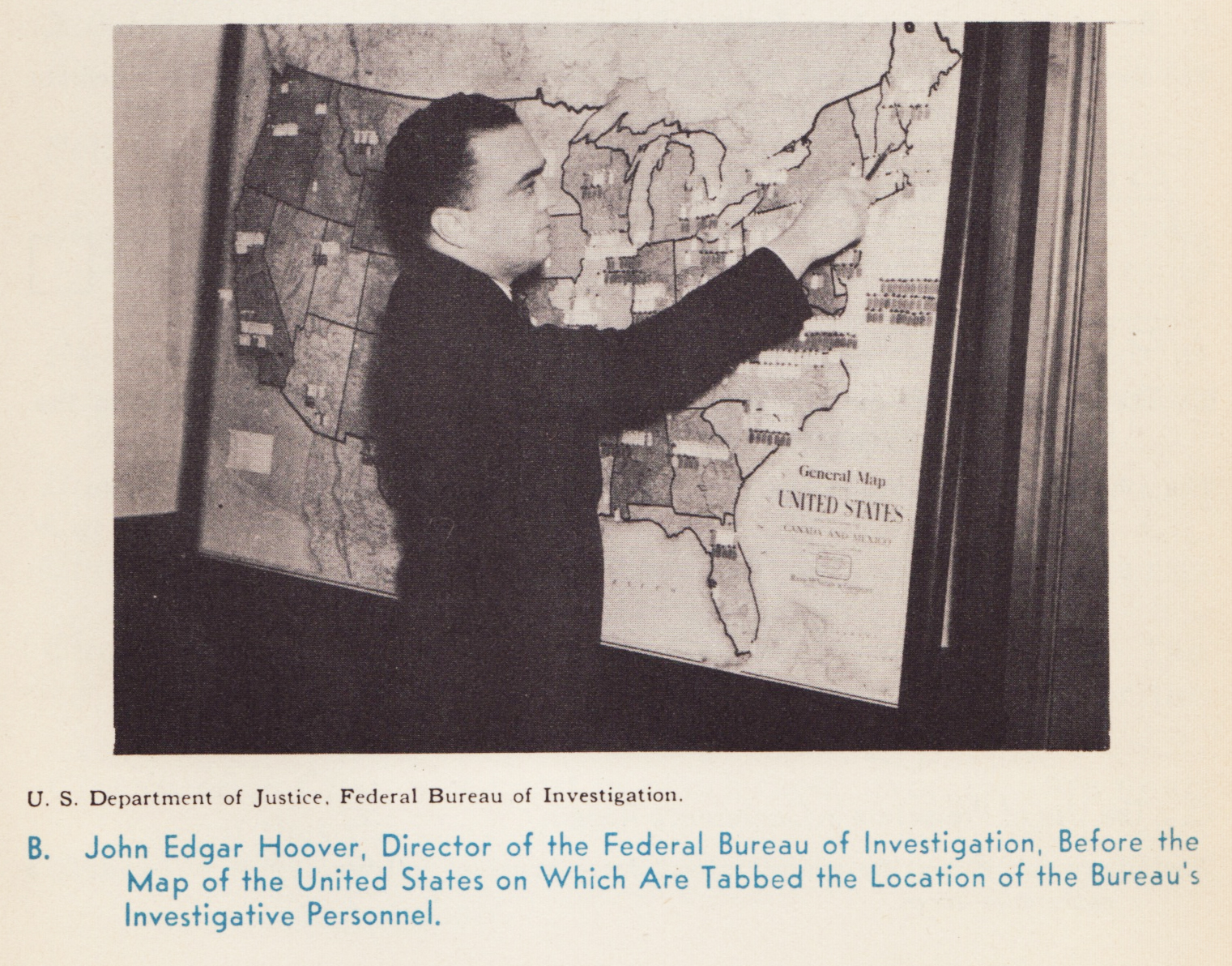
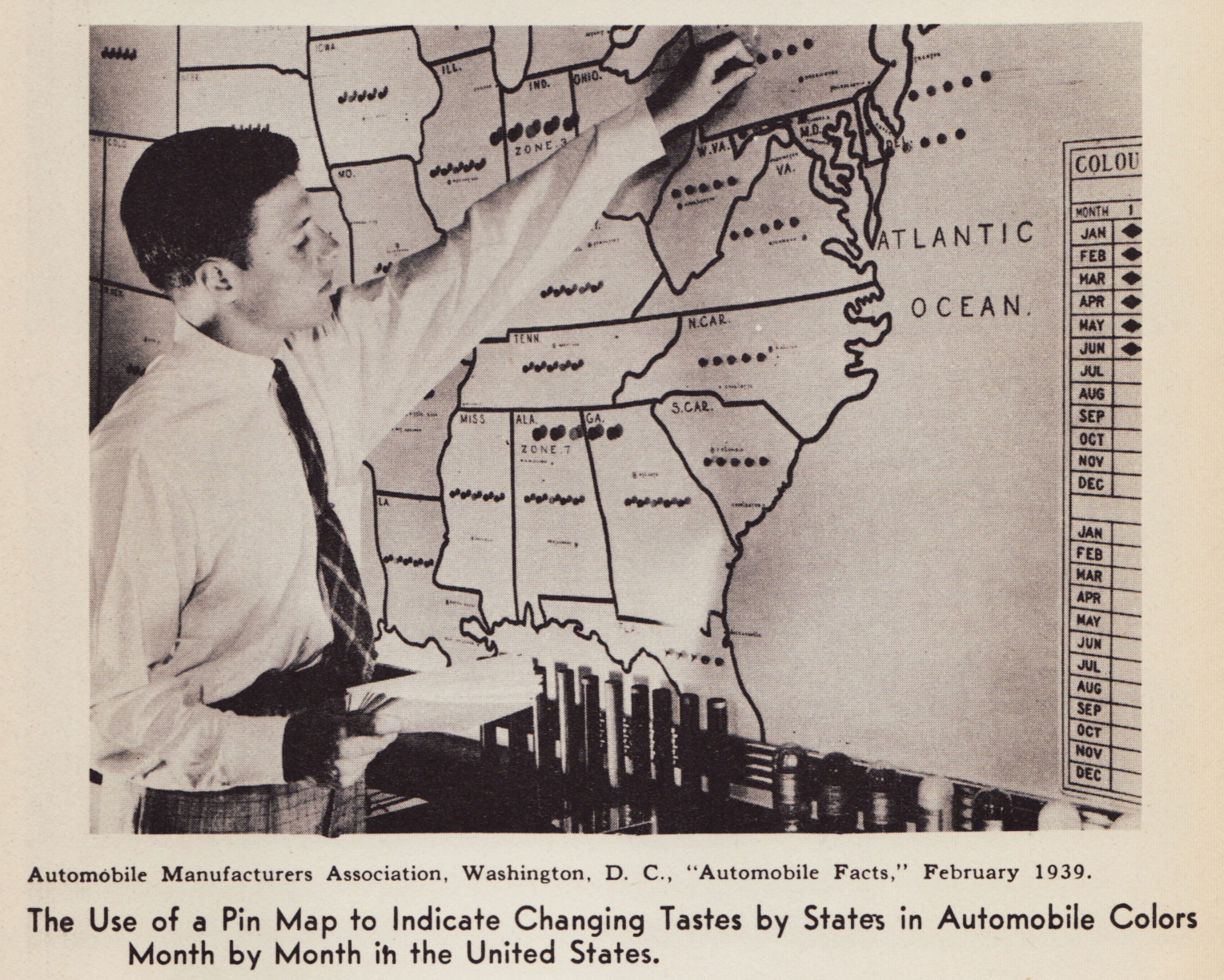
When I compiled a previous post entitled “A Discourse on Map Pins and Pinnage,” largely based on Willard C. Brinton’s Graphic Methods for Presenting Facts (1914) I rather forgot that Brinton had another tome, published in 1939, entitled Graphic Presentation.

Among the pages of this latter book can be found a few items worthy of note: J. Edgar Hoover pinning a map of FBI personnel (above), and another image of a map being pinned in the wild (most popular automobile colors, by U.S. state, 1939):

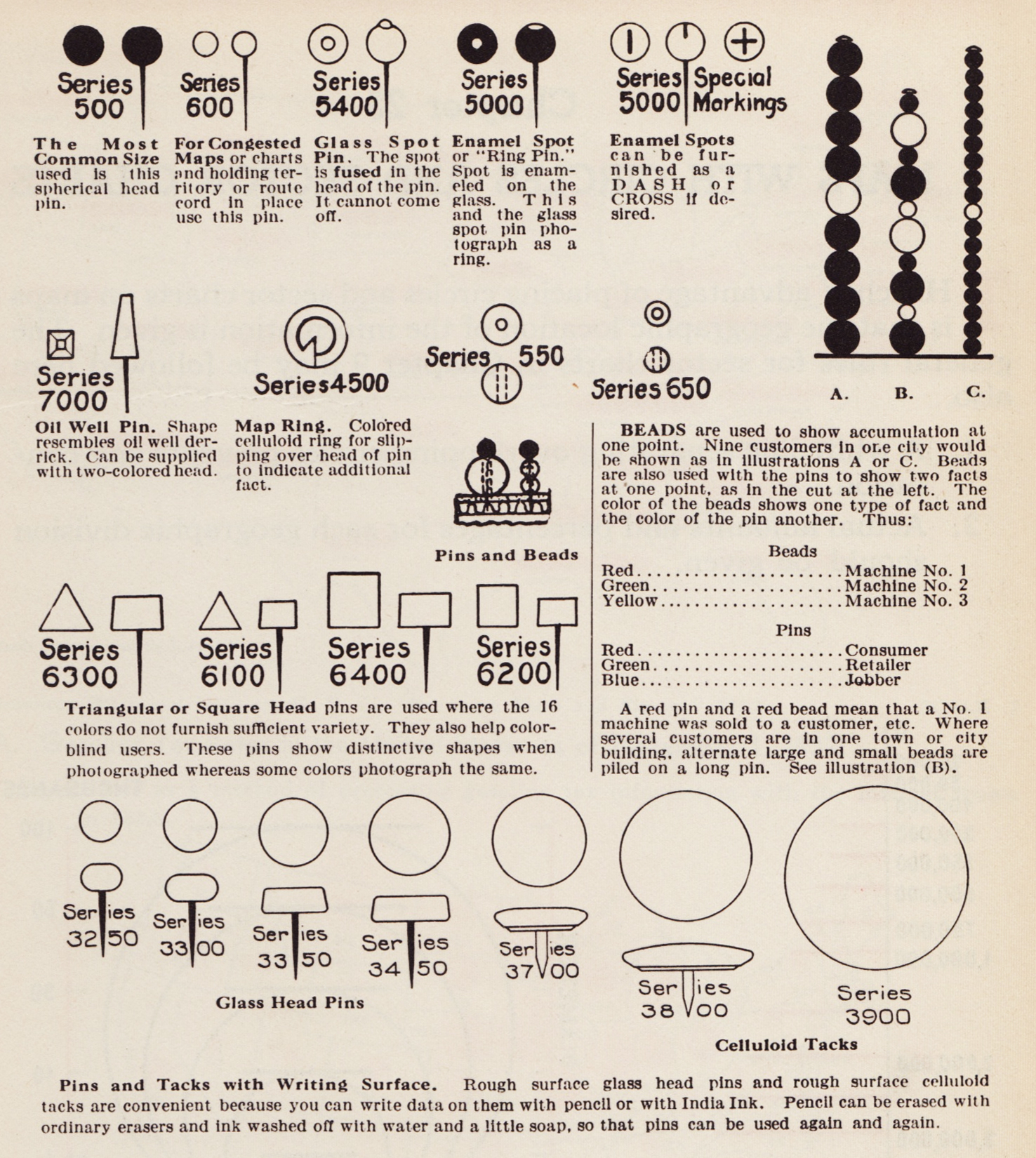
Also, a fine selection of map pins, updated for the demands of map pinners in 1939:

A few other stray map pin items have also come to my attention.

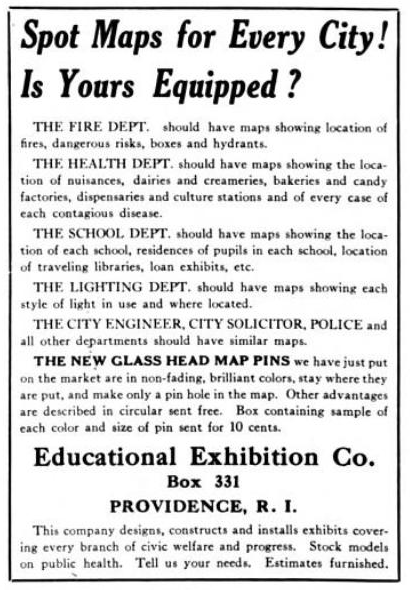
An advertisement in The American City (11, 1914) suggesting pinned maps EVERY city should construct:

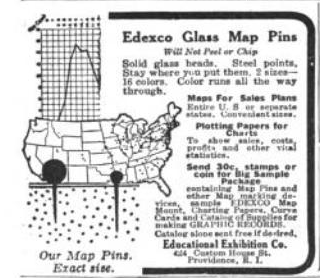
Or one from System: The Magazine of Business (33, 1918):

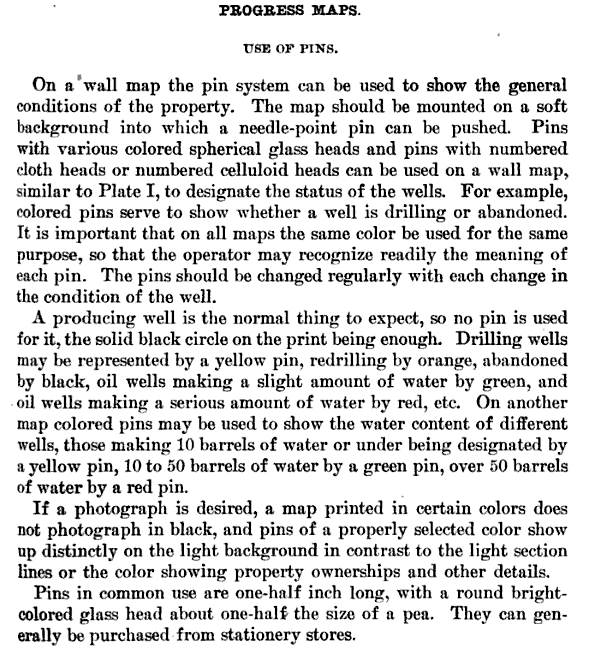
Or a bit of advice on using pinned “progress maps” in oil field work (Underground Conditions in Oil Fields, U.S. Department of the Interior, 1920):

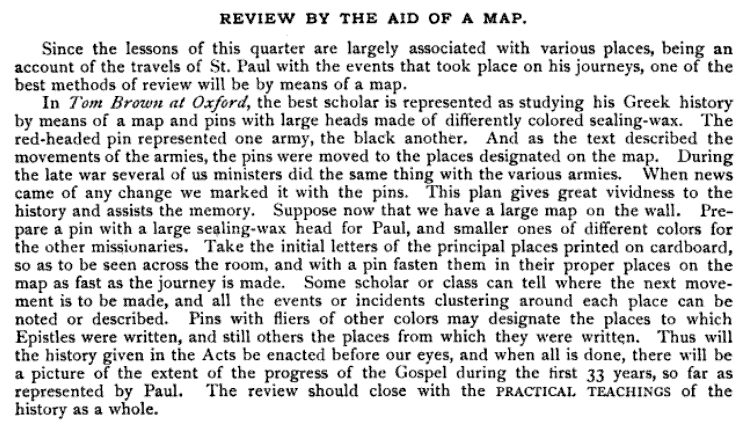
In Select Notes: A Commentary on the International Lessons for 1893 the Rev. Peloubet recalls the use of map pins for Bible study in the novel Tom Brown at Oxford:

Run out of map pins? Your local dealer is all out due to war-time demands? Popular Mechanics (March 1945) has instructions for DIY map pins:

Enough on map pins already.

Read Full Post »
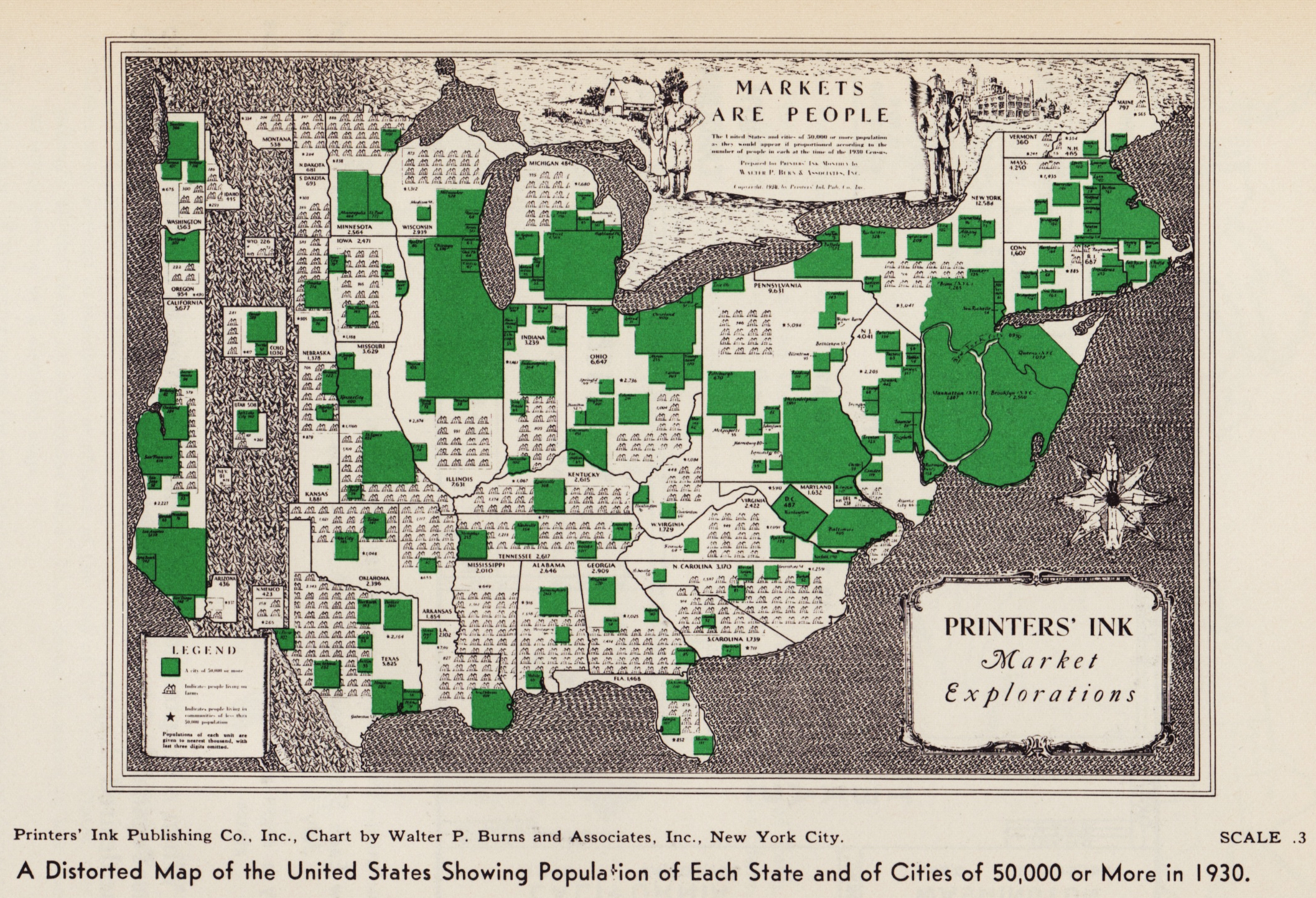
Cartogram, 1930: “A Distorted Map of the United States Showing Population of Each State and of Cities of 50,000 or More in 1930” (Printers’ Ink Publishing Co., Inc., Chart by Walter P. Burns and Associates, Inc., New York City)

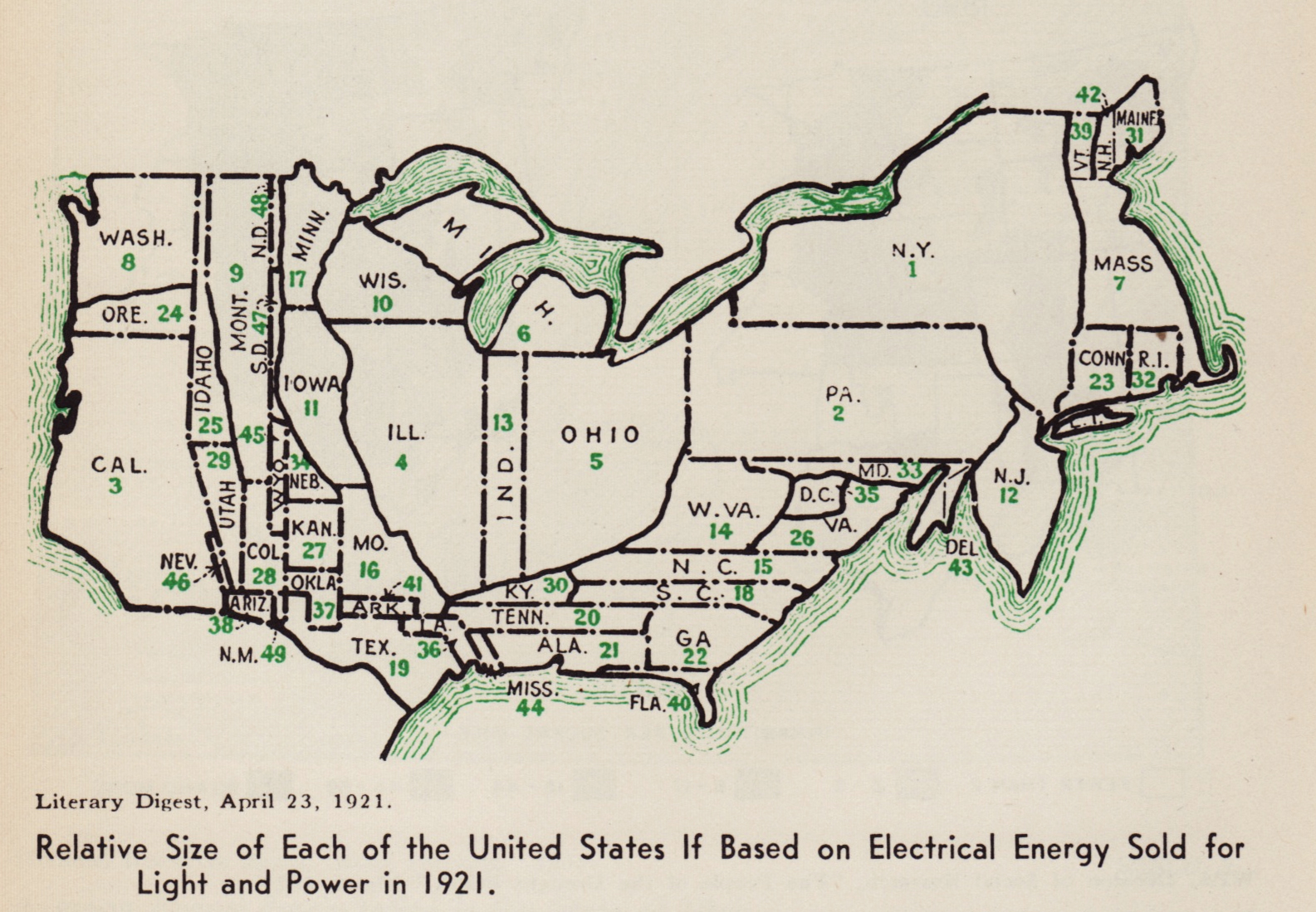
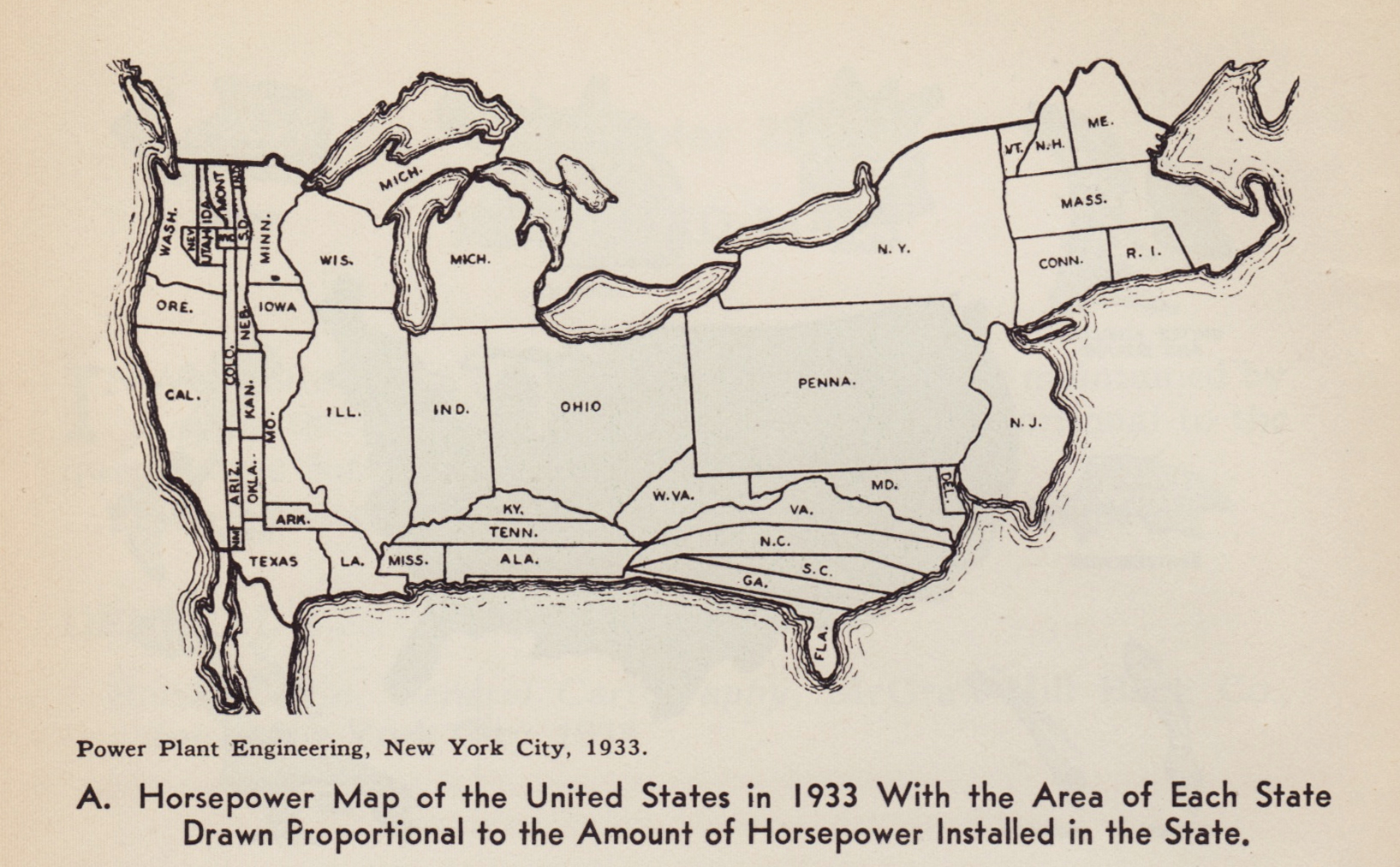
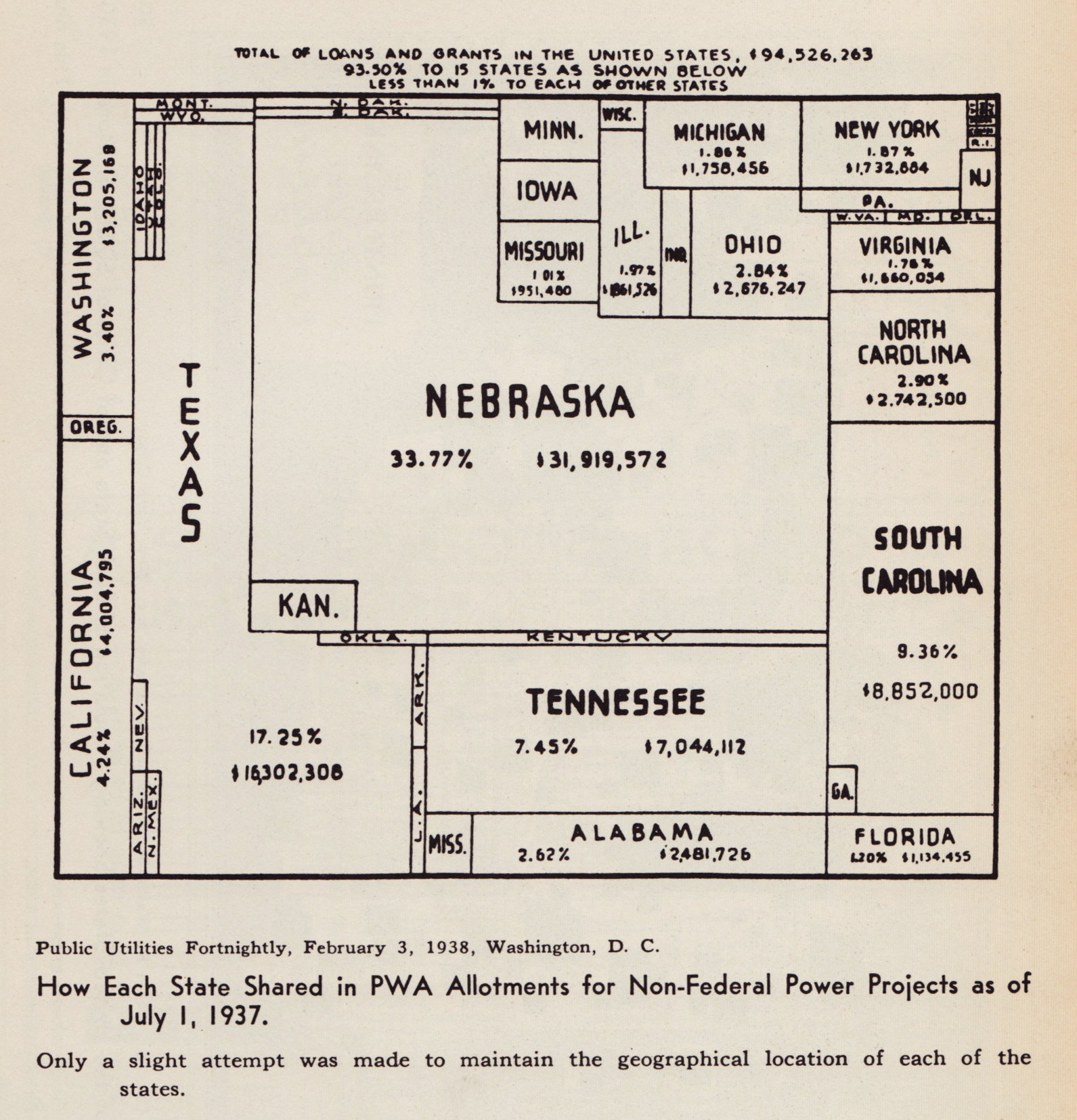
A cartogram scales geographic areas to some value other than geographic area. In two previous blog posts, 1911 Cartogram: “Apportionment Map” and 1923 Patented Cartogram, a few old-school cartograms were resurrected from musty old publications. Here find eight more cartograms published between 1921 and 1938.

This post opens with a peculiar item – the U.S. states as well as the areas of major cities are scaled to population, in essence two cartograms together. Symbols representing “people living on farms” are scattered about, each symbol equal to a number (undisclosed) of persons. Weird.

From the Literary Digest in 1921:

Cartogram, 1921: “Relative Size of Each of the United States if Based on Electrical Energy Sold for Light and Power in 1921” (Literary Digest, April 23, 1921)

•••••••••••••••

Cartogram, 1931: “The United States With the Area of the States Proportional to the Urban Population of 1930” (The Dartnell Corp., Chicago, Ill., 1931)

•••••••••••••••

Cartogram, 1933: “Horsepower Map of the United States in 1933 With the Area of Each State Drawn Proportional to the Amount of Horsepower Installed in the State” (Power Plant Engineering, New York City, 1933)

•••••••••••••••

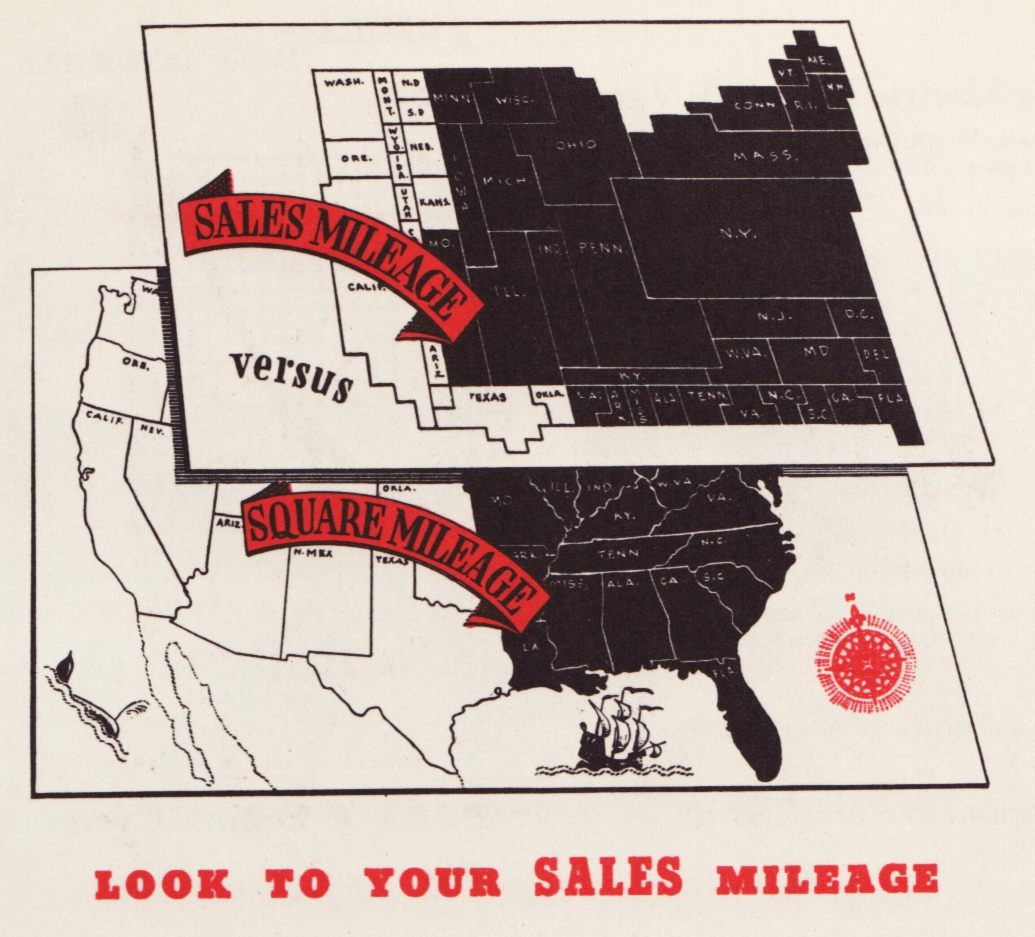
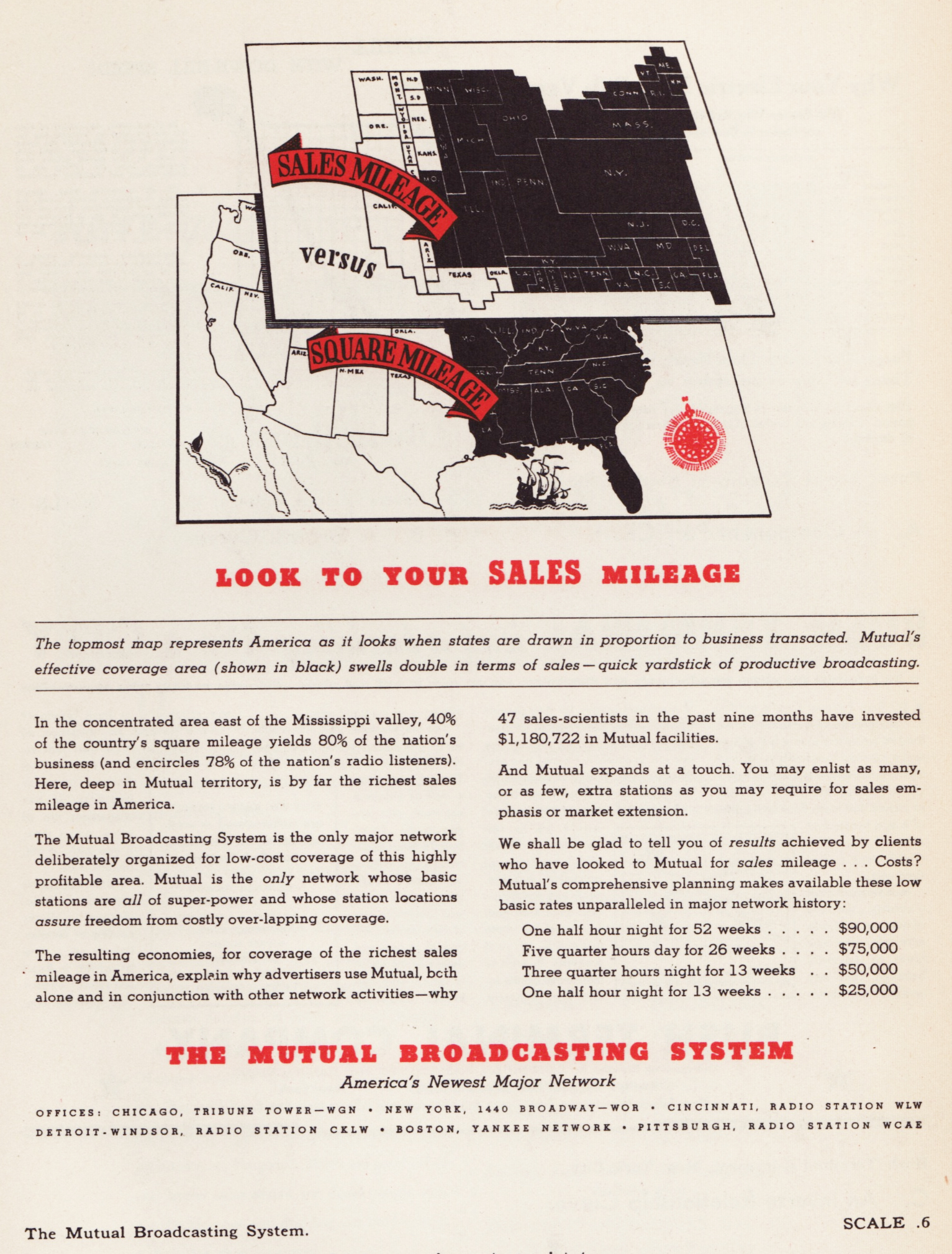
I had an old slide of the following cartogram but did not know its source: turns out it is from an advertisement for The Mutual Broadcasting Network, showing that 80% of business in the U.S. is transacted in states east of the Mississippi – MBN’s broadcasting area:

Cartogram, date unknown (1930s): “Look to Your Sales Mileage” advertisement (The Mutual Broadcasting System).

•••••••••••••••

A very diagram-ish cartogram which places an un-cartogrammed map of the US in the background:

Cartogram, 1937: “The United States With the Areas of the States Proportional to Their Manufacturing Output in 1935” (Business Week, June 12, 1937, New York City)

•••••••••••••••

brinton_gp_cartograms_1938

Cartogram, 1938: “How Each State Shared in PWA Allotments for Non-Federal Power Projects as of July 1, 1937” (Public Utilities Fortnightly, February 3, 1938, Washington DC)

•••••••••••••••

Reproduced from Willard C. Brinton’s Graphic Presentation (1939).

Read Full Post »
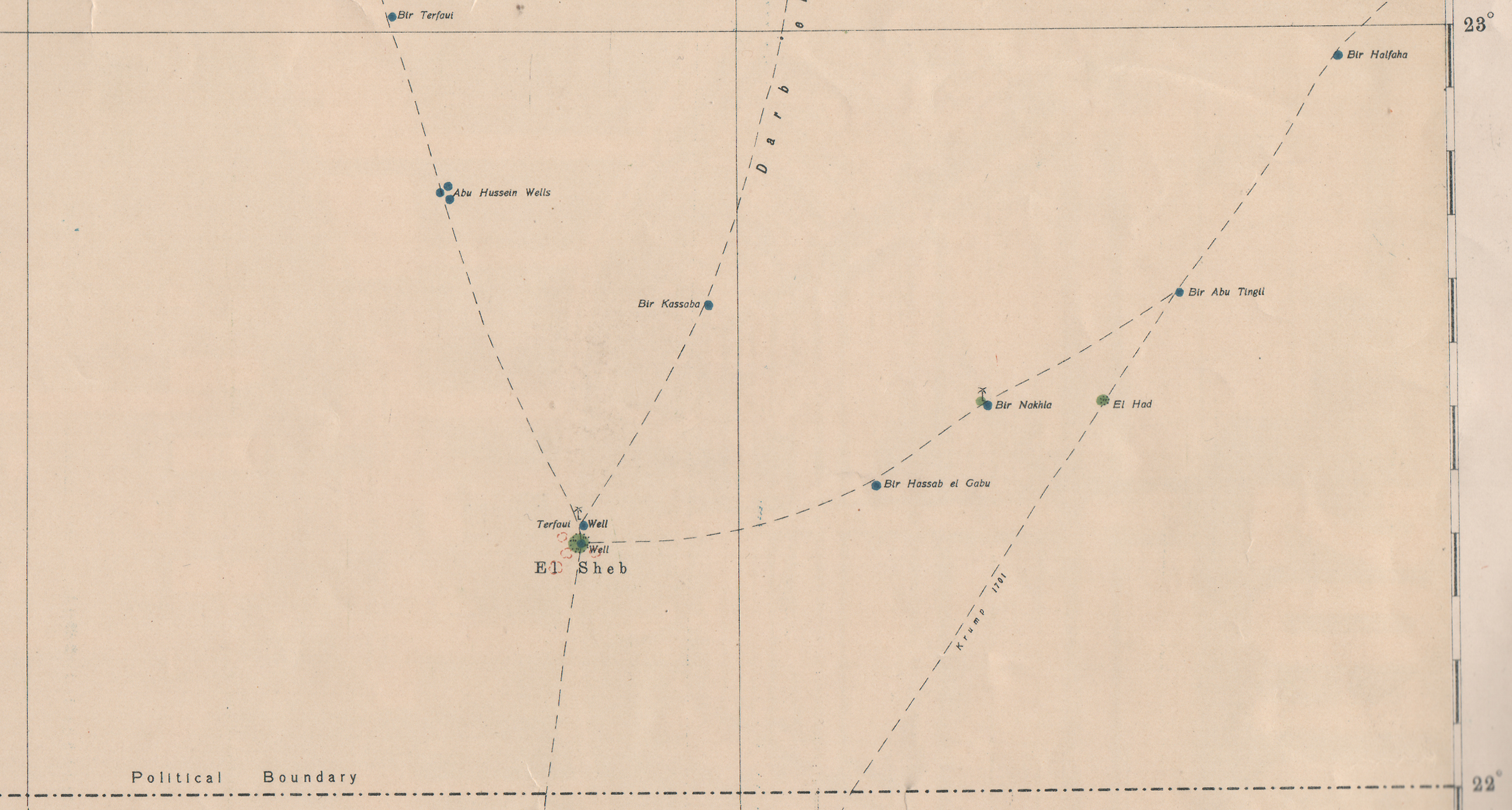
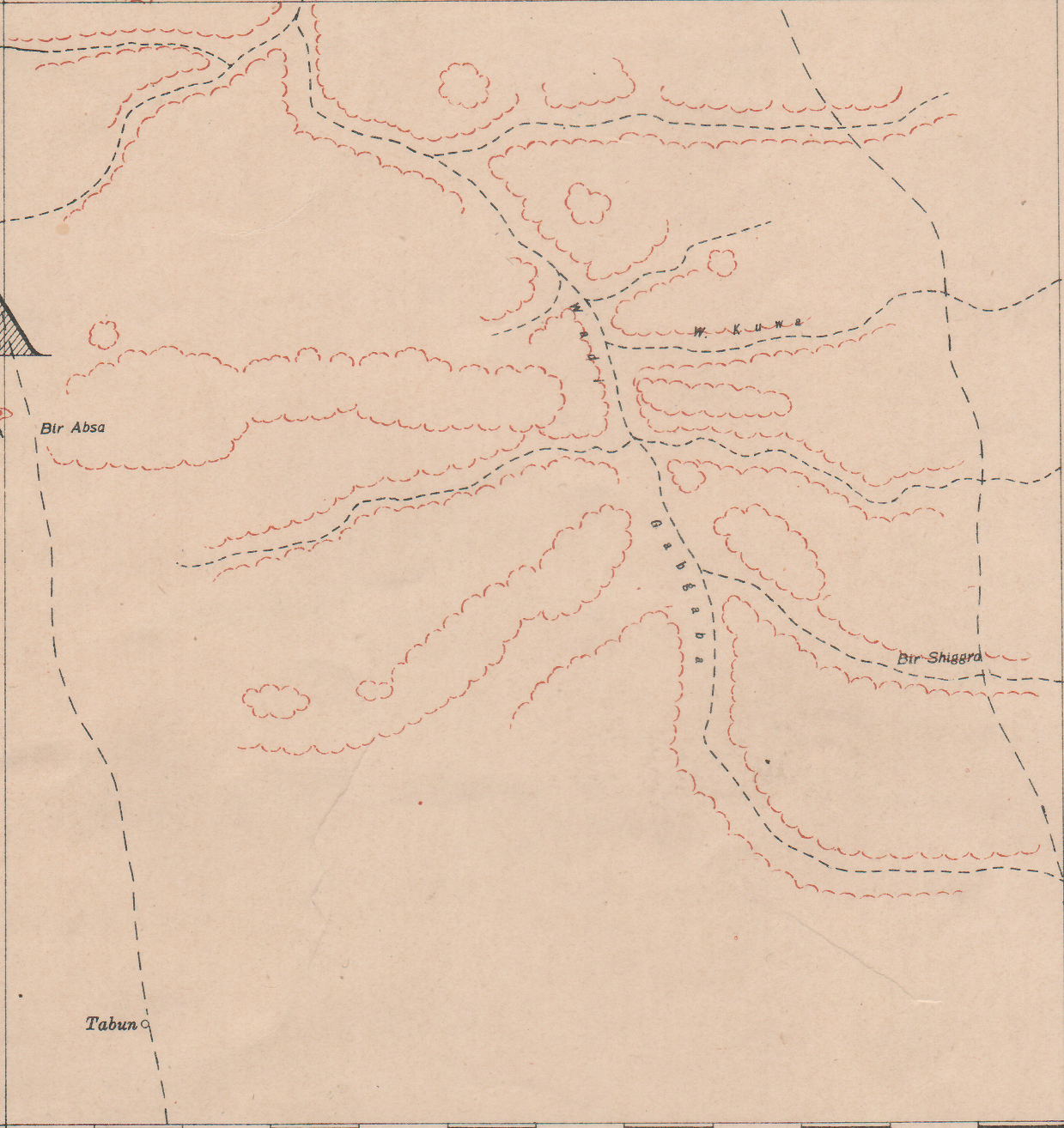
The Survey of Egypt, 1910, 1:1,000,000, Sheet 5 (detail 1, close-up)

•••

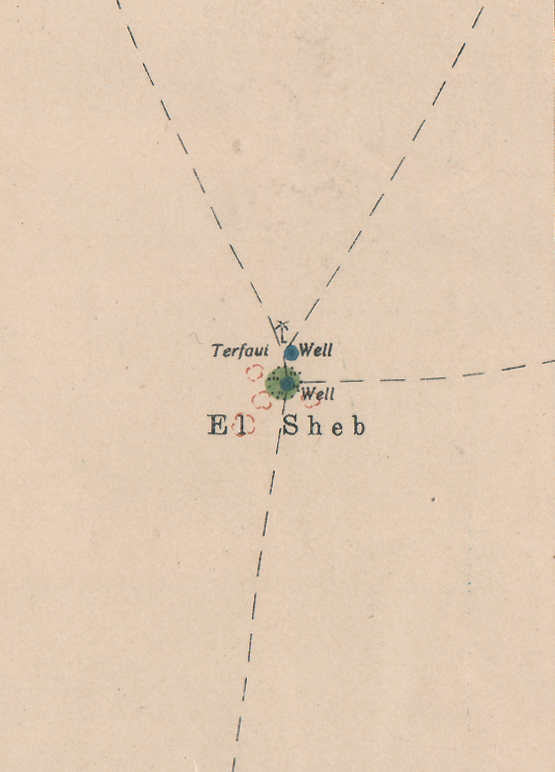
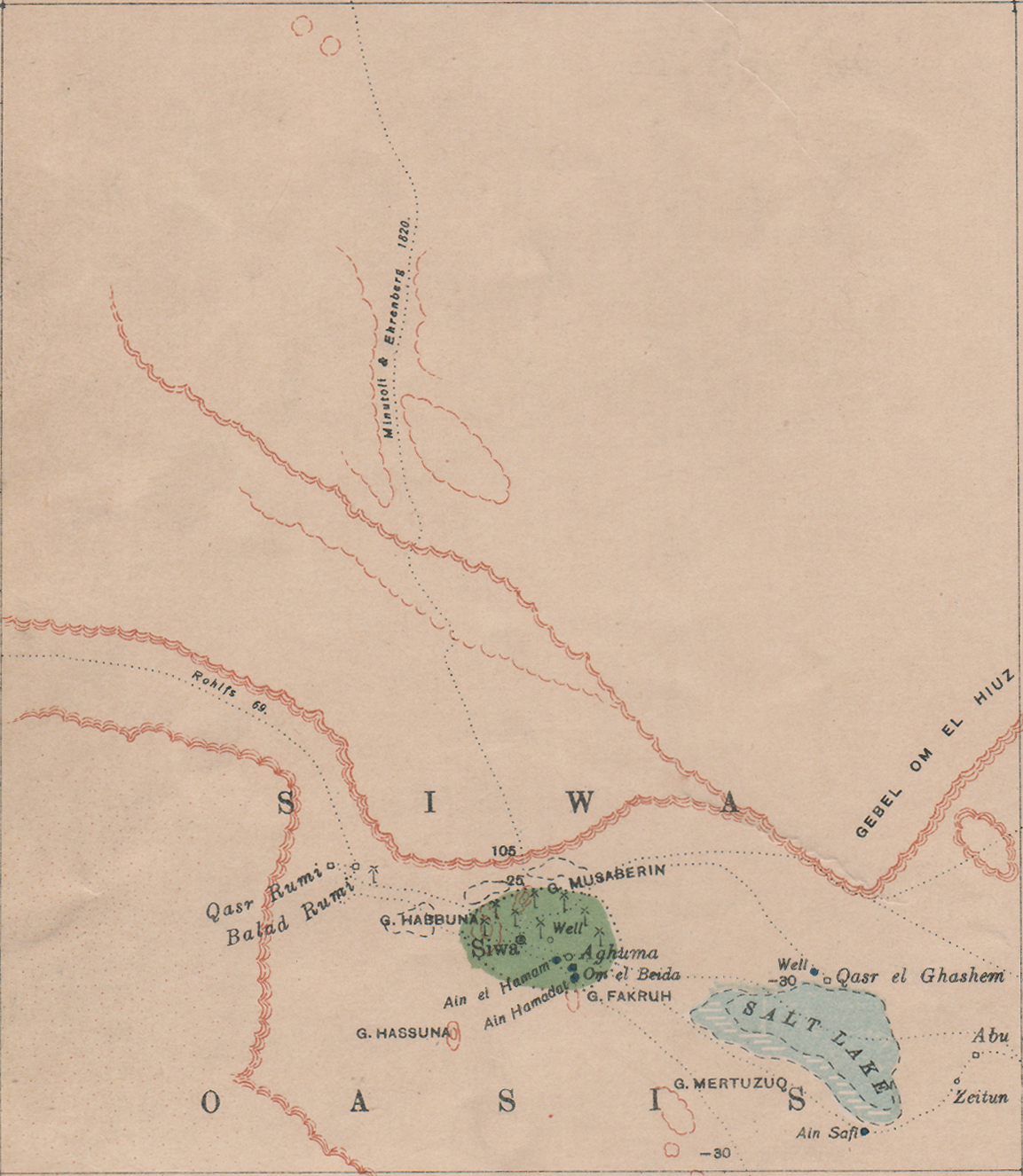
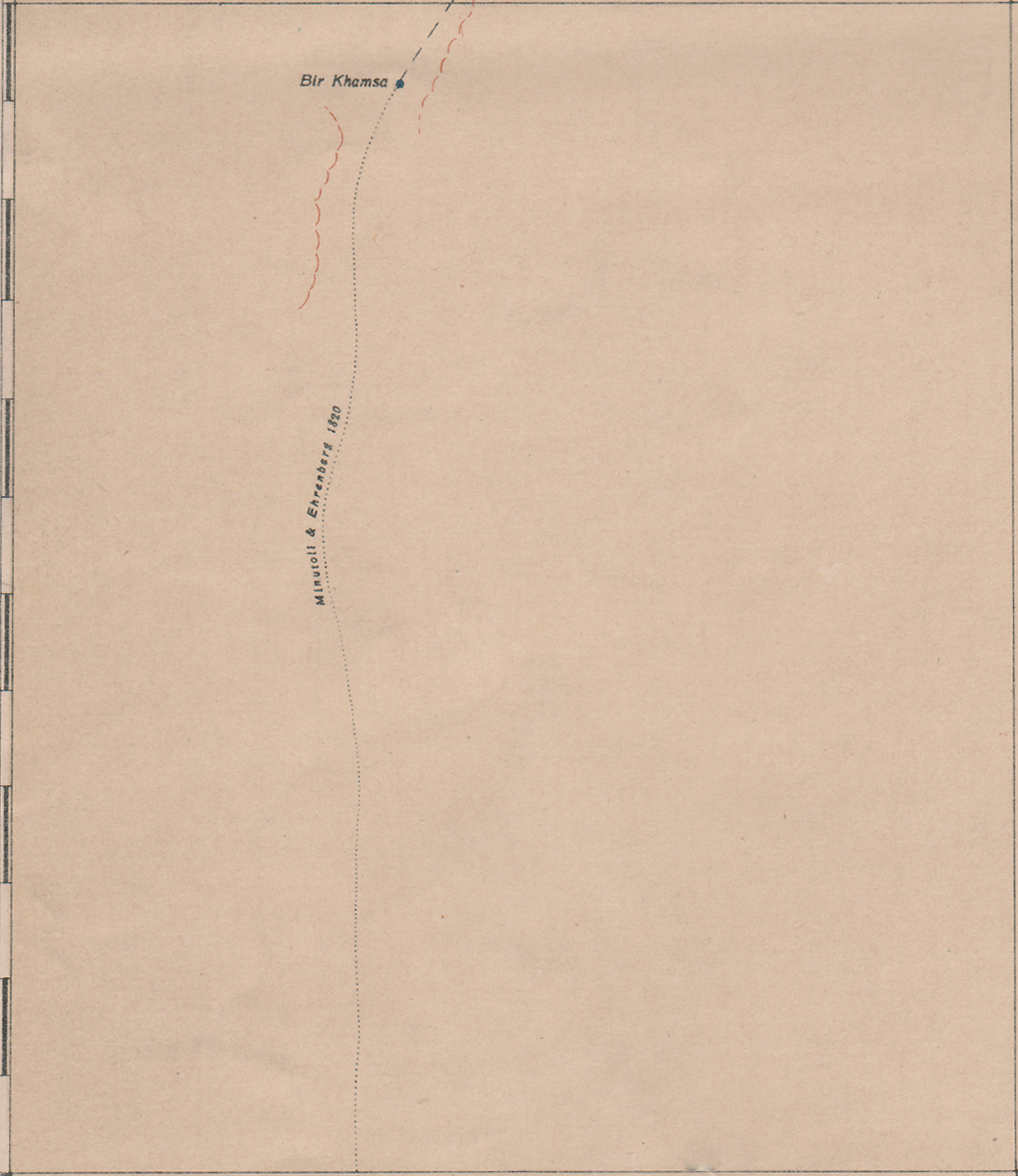
Found while cleaning out an old map cabinet: oceans of just about nothing, punctuated by signs of a minimal landscape. Soiled, creased, tears, dusty. Thumb-print and fading pencil marks, from someone who stared at this map a long time ago.

Details from a topographic map of Egypt in 6 sheets, published by The Survey of Egypt in 1910, scale 1:1,000,000.

Click on any map for a larger version of the scan.

•••

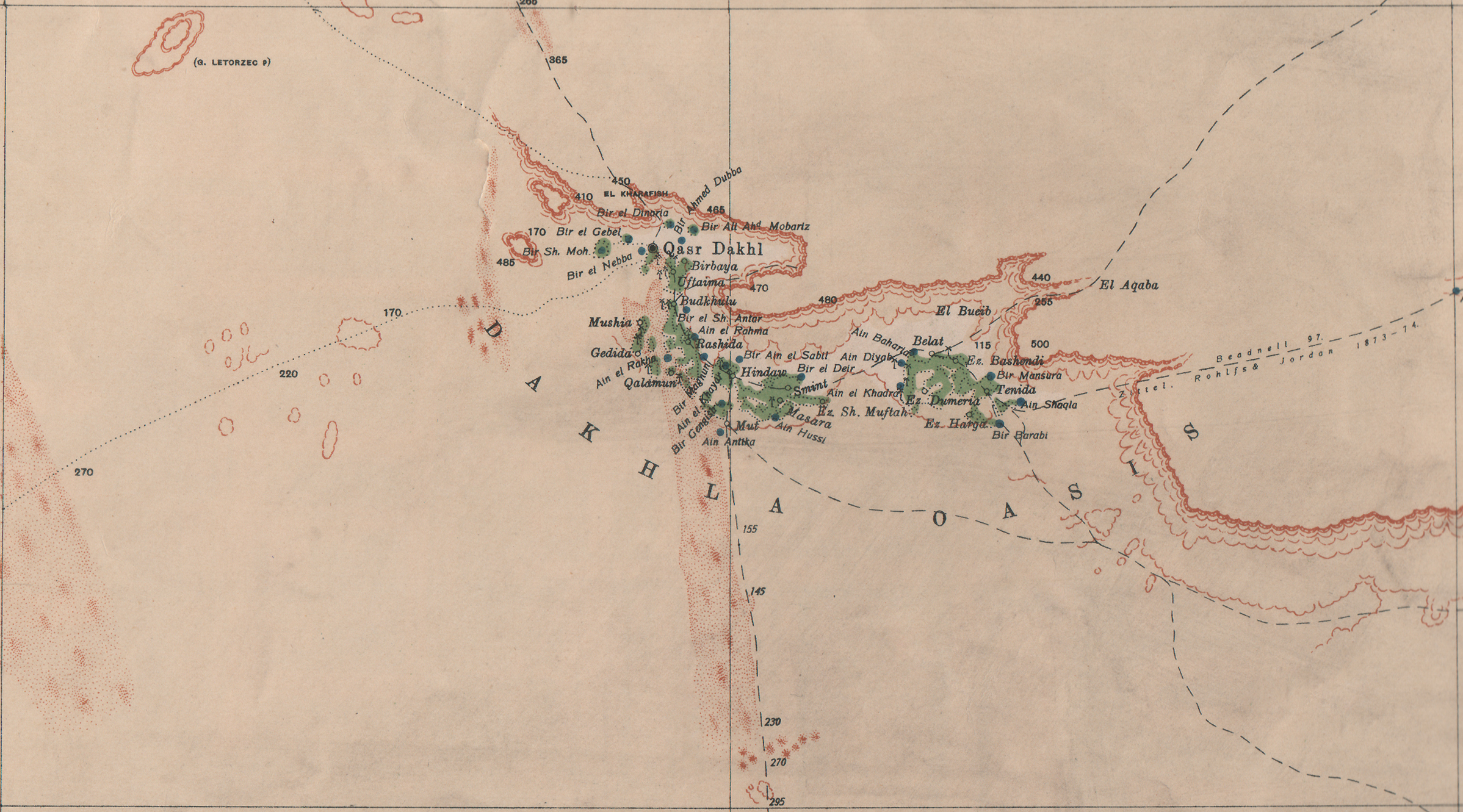
The Survey of Egypt, 1910, 1:1,000,000, Sheet 5 (detail 1)

•••

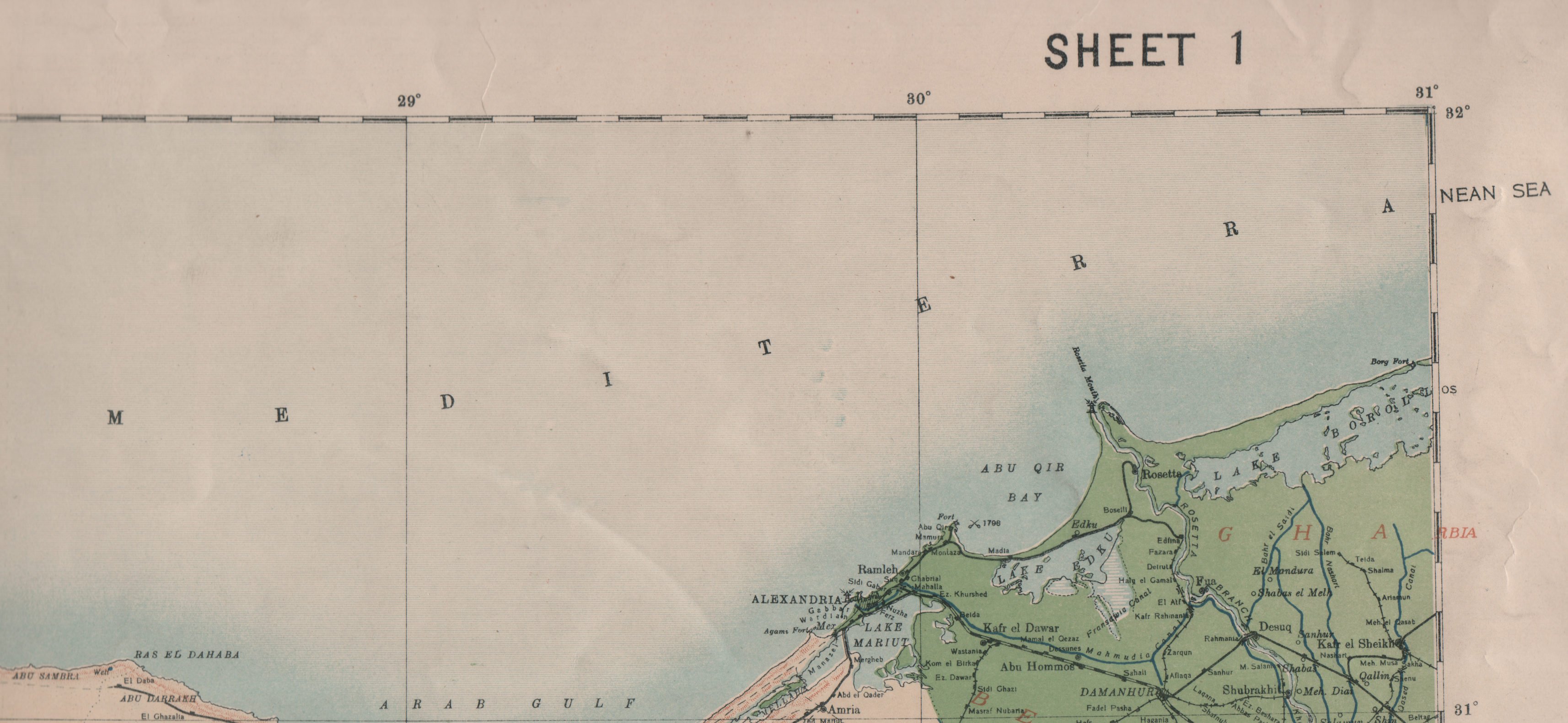
The Survey of Egypt, 1910, 1:1,000,000, Sheet 1 (detail 1)

•••

The Survey of Egypt, 1910, 1:1,000,000, Sheet 1 (detail 2)

•••

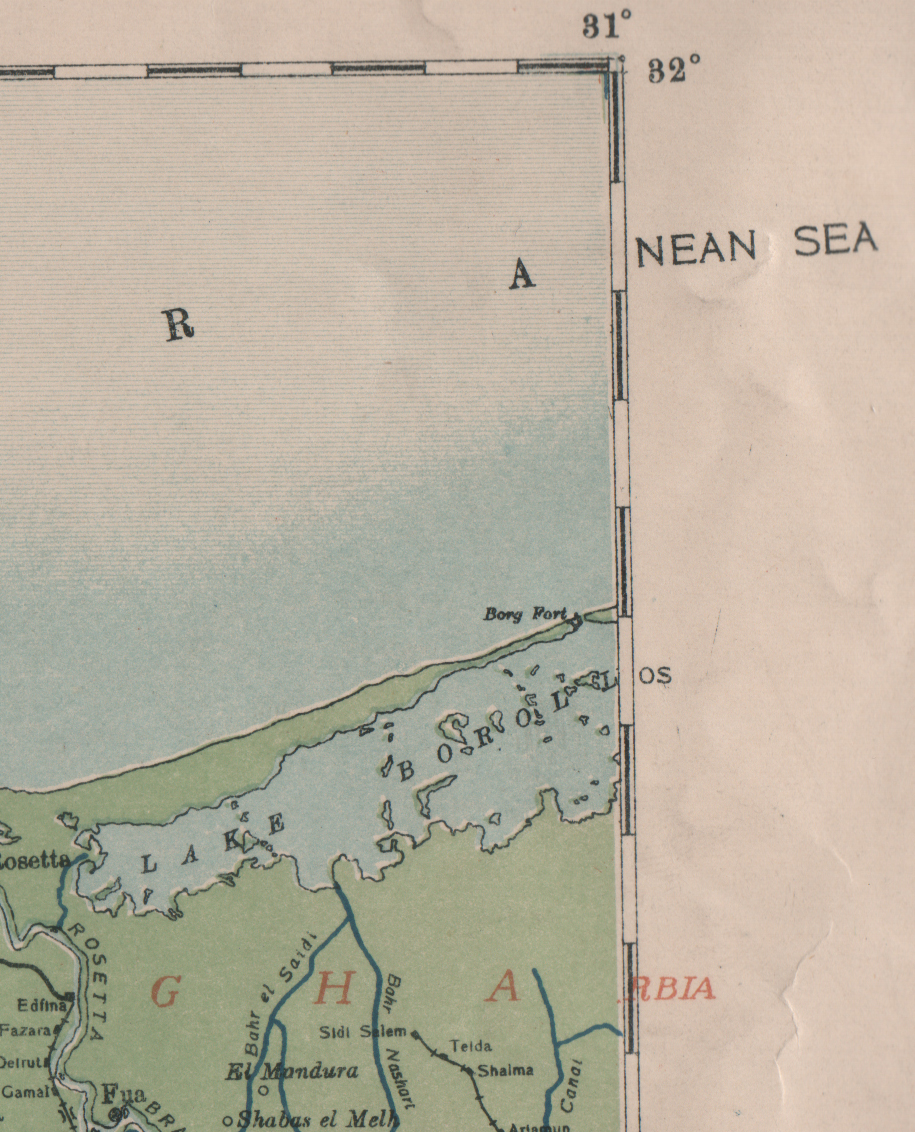
Note the type leaking over the map border (Mediterranean, Lake Borollos, Gharbia)

The Survey of Egypt, 1910, 1:1,000,000, Sheet 1 (detail 3 – close-up)

•••

Note the type leaking over the map border (Mediterranean, Lake Borollos, Gharbia)

The Survey of Egypt, 1910, 1:1,000,000, Sheet 1 (detail 3)

•••

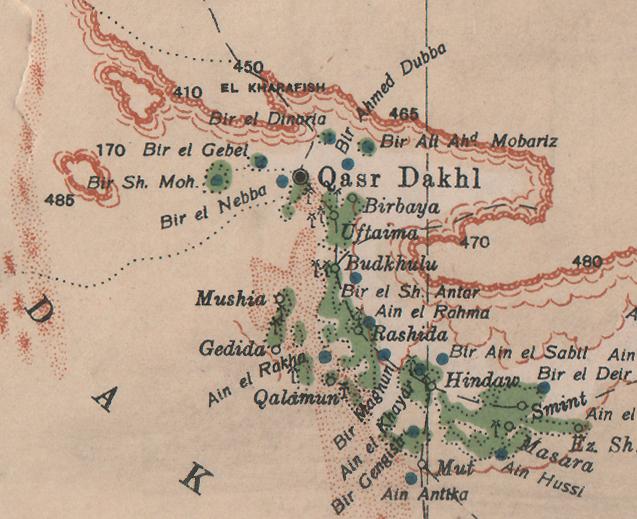
The Survey of Egypt, 1910, 1:1,000,000, Sheet 3 (detail 1 – close-up)

•••

The Survey of Egypt, 1910, 1:1,000,000, Sheet 3 (detail 1)

•••

The Survey of Egypt, 1910, 1:1,000,000, Sheet 5 (detail 2)

•••

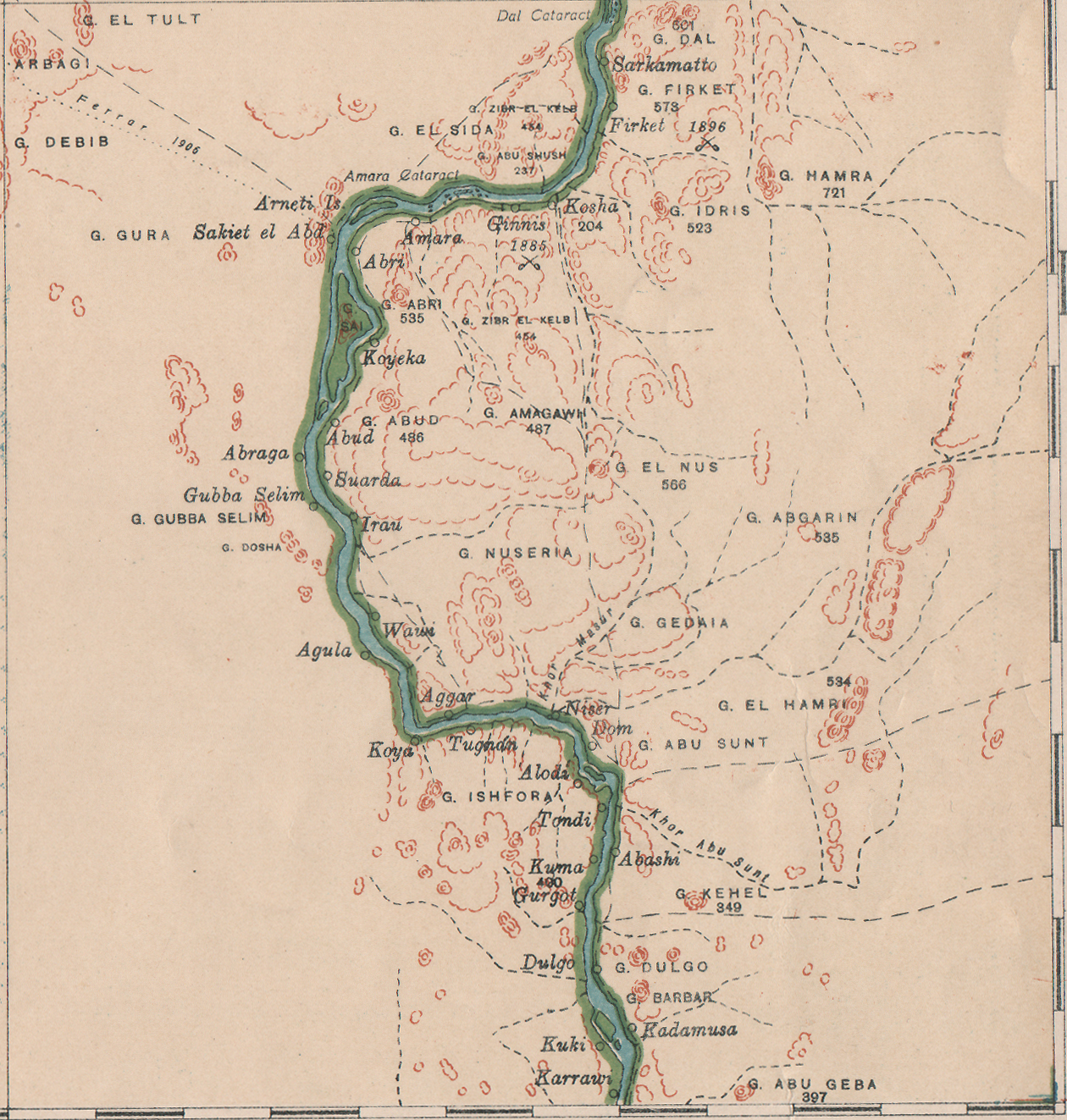
The Survey of Egypt, 1910, 1:1,000,000, Sheet 6 (detail 1)

Read Full Post »
Denis Wood’s Everything Sings: Maps for a Narrative Atlas

Now shipping from Siglio Press

Use discount code PUMPKIN for 20% off until November 12, 2010

Three maps from Everything Sings are below

Sidewalk Graffiti | Wind Chimes | Radio Waves

•••••

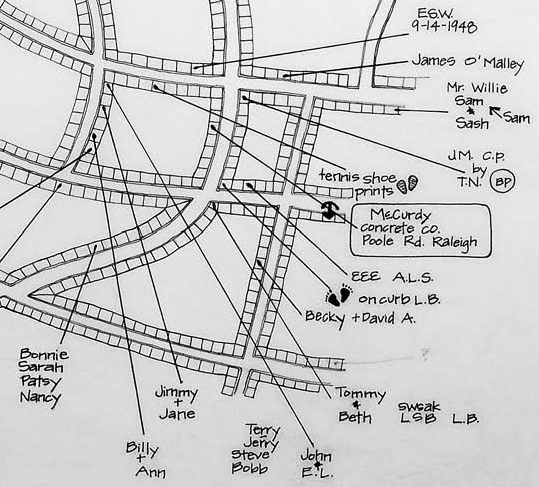
Sidewalk Graffiti (detail)

Scratched, scrawled, or stamped into drying concrete—mostly from the 60s into the 80s—is a fragmentary and tragically conventional body of folklore.

Sidewalk Graffiti (click to enlarge)

•••••

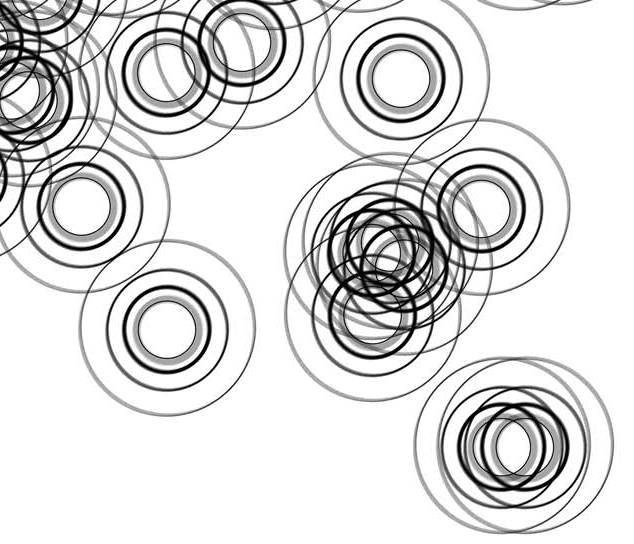
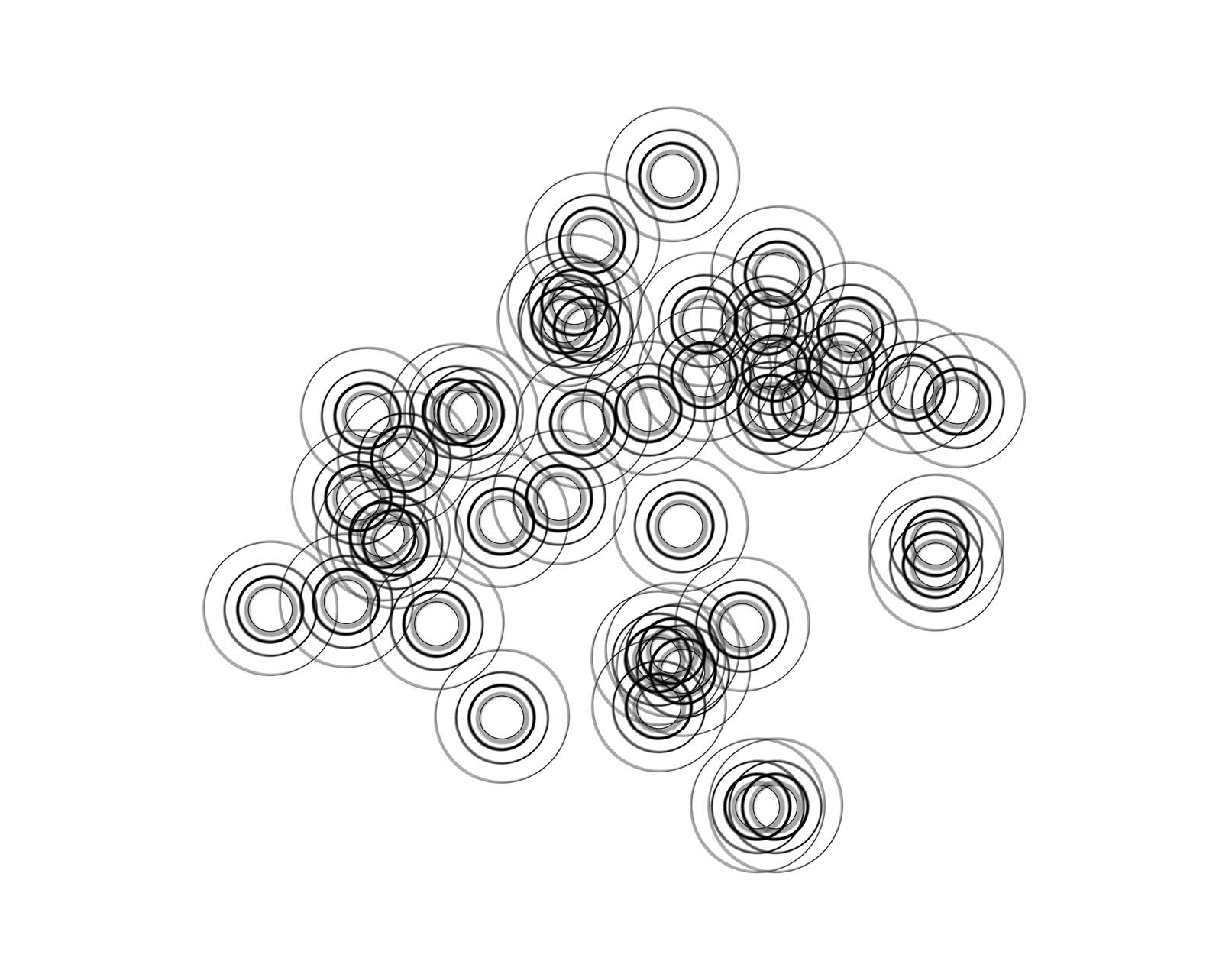
Wind Chimes (detail)

When we did the house types survey, we also paid attention to the presence of wind chimes. They were all over—bamboo, glass, shell, metal tubes. Depending on where you stood, the force of the wind, and the time of day, you could hear several chiming, turning the neighborhood into a carillon.

Wind Chimes (click to enlarge)

•••••

Radio Waves (detail)

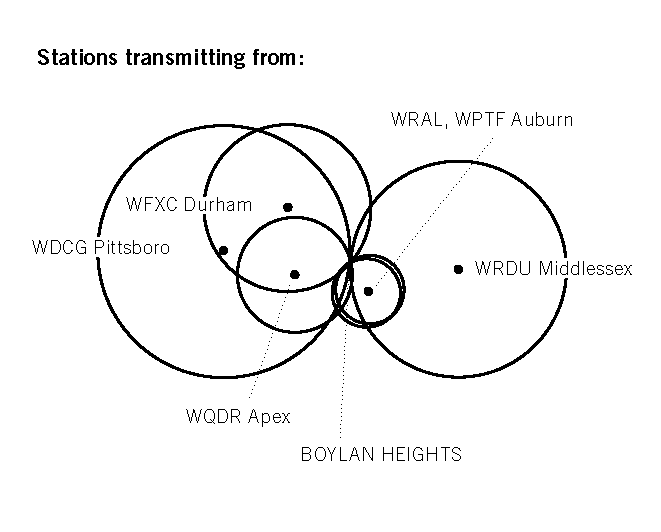
Unlike the wave fronts of wind chimes which—requiring a lot of energy to move the air molecules—never get very large, radio waves don’t propagate in air. They propagate in space and travel undisturbed through non-metallic objects like house walls and bodies. Depending on the location of the transmitter, their wave fronts can be enormous, yet they pass through the neighborhood silently, unfelt, and unnoticed, unless tuned into. In the mid-1980s, Boylan Heights listened mostly to a mix of Top 40, Oldies, Country, R&B, and talk radio on six radio stations: WDGC transmitting from Pittsboro, WFXC from Durham, WQDR from Apex, WRDU in Middlesex, WRAL and WPTF from Auburn. As the neighborhood has changed, so have the radio stations it listens to. Today, it’s mostly NPR broadcast by WUNC in Chapel Hill.


In the key, Boylan Heights is the point of tangency of these six fronts of radio waves. On the map, you can see which waves belong to which stations by their shape and direction. Because radio waves are concave to their point of origin, a wave concave to the lower right (southeast) is coming from Auburn, and one concave to the upper left (northwest) is from Durham. The degree of curvature depends on the size of the wave front and its distance from the source: the straighter the line, the farther away the transmitter. (Sensible curvature decreases with size which is why the earth seems flat.) These wave fronts, ever expanding, make different patterns in other places.

Radio waves also come from the stars. Their wave fronts are effectively flat and they come from every direction, silently, unfelt, and unnoticed.

Radio Waves (click to enlarge)

•••••

Read Full Post »
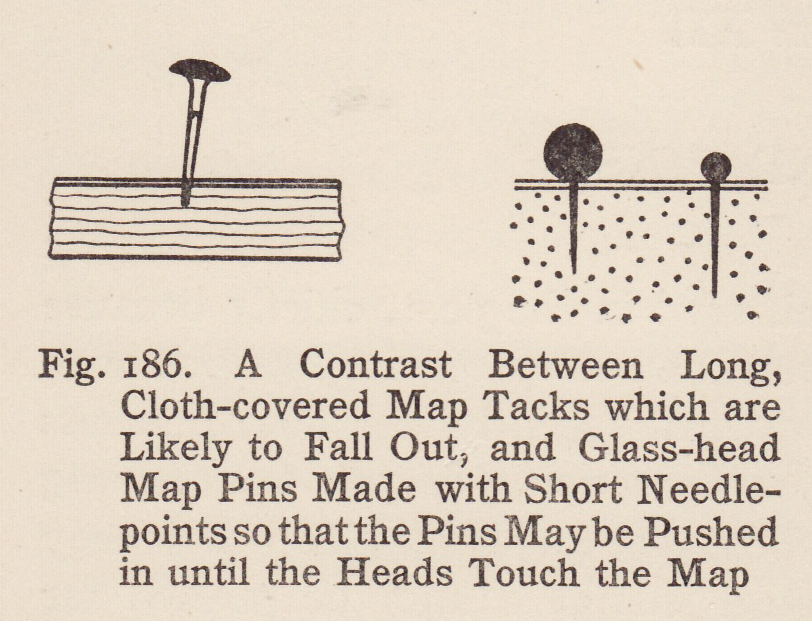
Pin maps have not much been much used in the past, chiefly because a map pin which would give satisfactory service has not been available for common use. Until recently the map markers obtainable have been little more than old-fashioned carpet tacks having chisel-shaped points which cut the surface of any map into which they were pushed. Tacks with rough steel shanks cannot be pushed far into a map if the tacks are to be pulled out again. Also, rough steel is likely to rust so as to cause the whole tack to deteriorate rapidly.

Thus begins a discourse on the map pin – and its brethren map beads, flags, and buttons – by Willard C. Brinton in his Graphic Methods for Presenting Facts (1919). In chapter 12 of that formidable volume, “Maps and Pins,” (2.5mb pdf) we are treated to 27 pages of considered commentary on the map pin: undoubtedly everything that could be said about map pins at the time. May I suggest cartopinography as the appropriate nomenclature for this deliciously narrow subset of the cartographic arts? Yes I may.

The shameful failings of mere tacks as map pins are amply demonstrated in the Brinton screed:

An alternative universe of map pins, beads, flags, and buttons are offered up, and, of course, delightfully illustrated: I repeat the opening image followed by an annotated list of map pin descriptors:

1. Long pin with small size glass head, available in many colors.
2. Long pin of brass wire for use with beads as shown in No.9.
3. Long pin with glass head used in conjunction with a piece of sheet celluloid cut into the shape of a flag.
4. A celluloid flag, with beads above the flag to represent quantity, or beads in different colors to denote various characteristics for the data portrayed. The grip of the sheet celluloid on the pin is sufficient to hold both the beads and the flag at the upper part of the pin.
5. Long pin with large size glass head, obtainable in different colors.
6. Pin like that shown in No.5 used with beads strung upon it.
7. A brass tack large enough to receive gummed labels which may be written upon with a pen.
8. Map pins having sharp points and small spherical glass heads in contact with the map. These pins are available in many different colors; the upper one in No. 8 is red and the lower one blue.
9. Beads in various colors of a size to correspond with the map pins in No. 8. Here the beads were red. White beads, used for every tenth position, show at a glance that there are 22 beads on the pin. Note that the color red photographs as black.
10. Map pins having sharp needle points and spherical glass heads in contact with the map. The pin is of the same general style as No. 8 but it has a head of larger diameter. This pin is obtainable in many colors.
11. Cloth-covered map tacks available in plain colors and in plaids.
12. Single bead used with an ordinary pin as a crude substitute for a regular map pin.
13. Beads in different colors corresponding in size with the map pin of No. 10.
14. Beads of two different sizes representing different things but at the same location.
15. Beads of two different sizes and three different colors. Since both sizes and colors may be varied, and almost any number of beads used on one pin, there are practically unlimited possibilities for the showing of complex data.
16. Beads on a pin which holds down on the map a sheet of colored celluloid cut to the exact shape of a small land area to which attention is directed.
17. A sheet-celluloid marker held by a map pin like that seen in No. 8.
18. Celluloid-covered tack, available in different colors.
19. Celluloid-covered tack with stripes of different colors.
20. Celluloid-covered tack with printed numbers from 1 to 99 inclusive.
21. Celluloid-covered tack having a rough surface so made that the surface may be written upon with pencil or pen, yet erased afterwards or rubbed off with a moist cloth. Lettering may be made permanent by means of a coat of varnish.
22. Large size celluloid-covered tack available in different colors.
23. Large size celluloid-covered tack with stripes of different colors.
24. Very large size celluloid-covered tack.

Included in the study are sundry illustrations of map pinnage at the zenith of development.

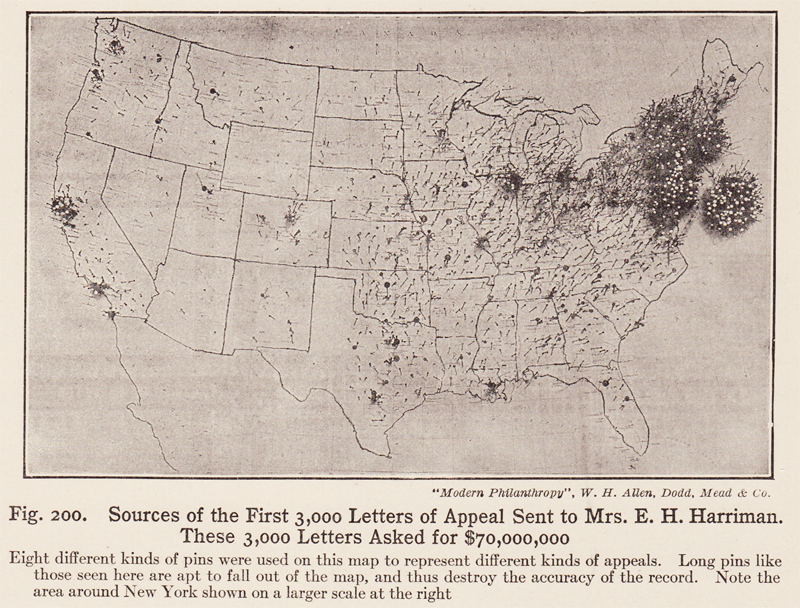
Below find a pin map showing the source of letters appealing for funds from Mary Harriman, the wife of railroad magnate E.H. Harriman. Mrs. Harriman’s fortune was somewhat reduced by the sheer number of map pins acquired for this exercise in cartopinography. Note the excessive pinning of New York City. So many pins are attempting to share the same geography that the map required an additional pin island (floating off the coast of New York city):

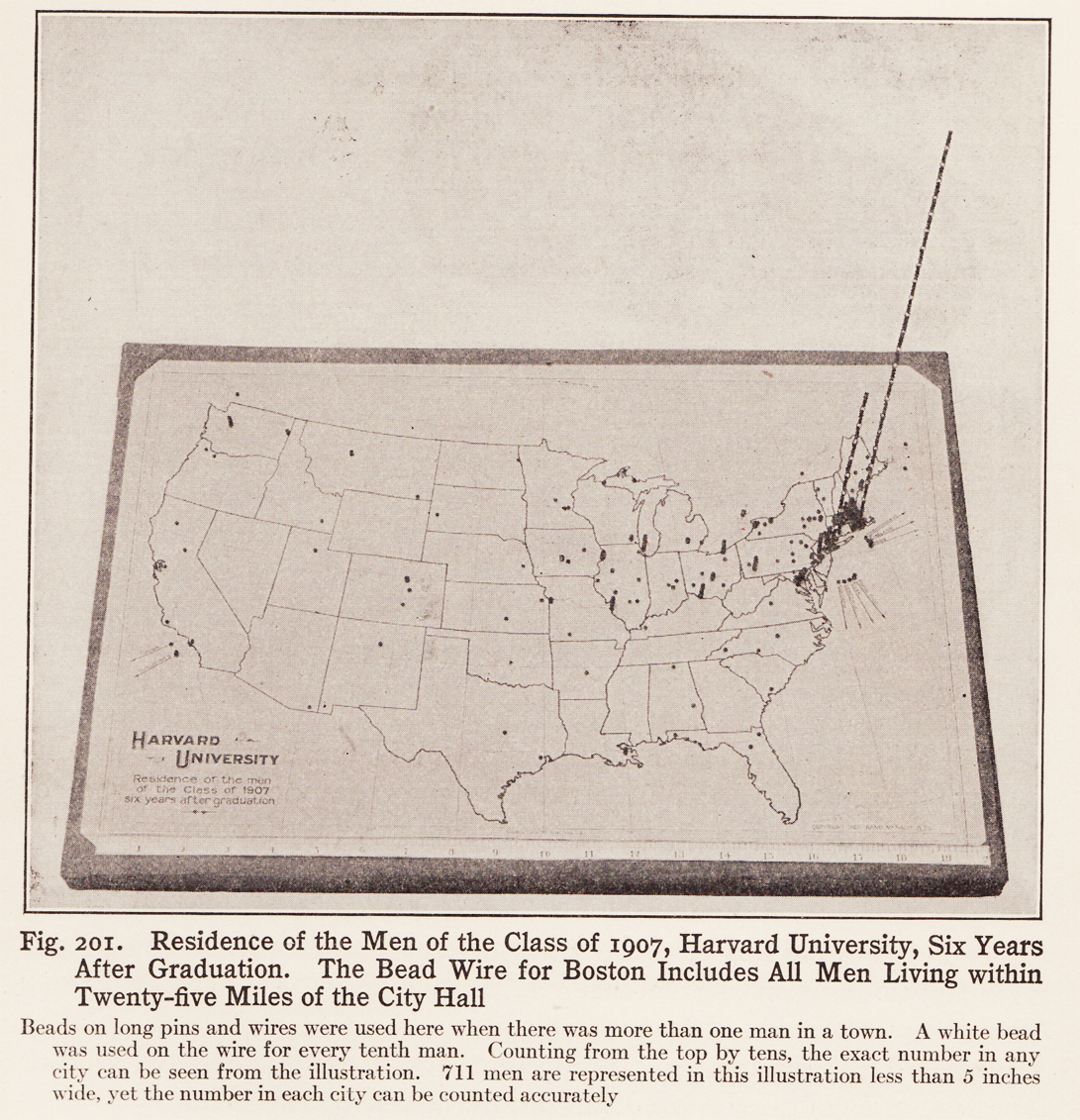
Harvard University, that hotbed of map pin innovation, confronted head-on the “too many pins in one place” problem that plagued the Harriman pin map. Why not, they suggested, create stacks of beads? Why not indeed!

The results, illustrated below, show the residence of 1907 Harvard graduates, six years after graduation. The map beads are stacked on a wire, every 10th bead is white. Why turn to a simple table when you could count beads on wires stuck in a map?

Further pin map considerations must be taken when attempting these protruding pin maps: such a bead map “should be mounted on several layers of corrugated straw-board to allow the long pins to sufficient depth in the mounting to hold fast.” One does not want teetering map pin beads!

The Harvard map sports six layers of straw-board, and a total thickness of 1 and 1/4 inches. Not only does such a sure base support the extensive beadage in the Boston area, but it is also “extremely light and very convenient to handle.”

Yes, I know what you are thinking: what kind of wire would one use for such a map? Would you believe piano wire? But some work is needed to transform piano wire into map bead wire. Brinton details the process: “The piano wire should be heated in a gas flame so as to remove some of the spring temper. After the wire has been heated it can be straightened and it will remain straight without continually springing back into coil form.” Once the heating and straightening has taken place, Brinton suggests a light coating of varnish to stabilize the wire used in longer columns, such as those for Boston and New York City on the map.

I suspect the Harvard map might suffer a bit of map bead flaccidity if hung upon a wall, given gravity and all. I also wonder about the hazards of such lengthy map beadings: a farsighted passer-by might, for example, receive a nasty map bead wire puncture-wound upon viewing the map too closely. No such injuries were reported in Brinton’s tome, however.

In our modern age of fancy maps-on-the-web the tangible map pin is certainly in decline. Yet a quick search leads to several suppliers of map pins, flags, and similar items, such as the Hudson Map company and The Map Shop.

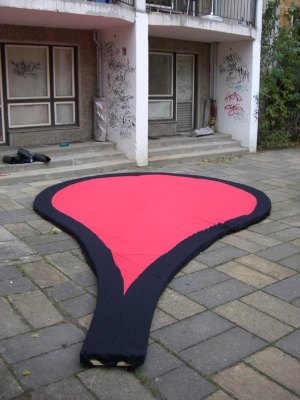
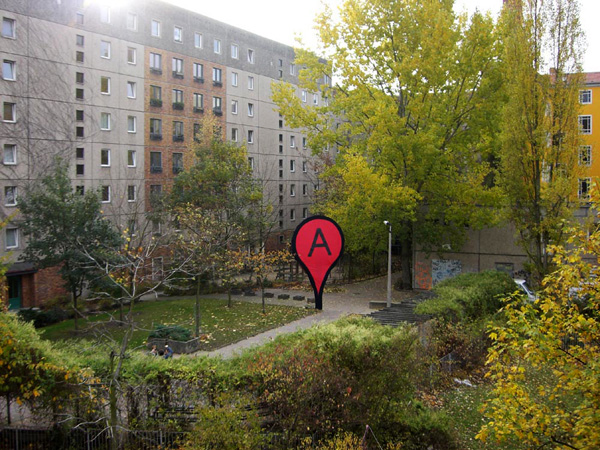
Yet it is the ubiquitous Google Map that has saved the map pin from obscurity. Google’s default map pin marker can certainly be replaced by any kind of marker you want (see Custom Map Symbols in Google Maps) but who wants to futz around with that?

The Google Map map pin has taken its place as a literal pop-culture icon. Indeed, Google’s digital map pin has leaked back into earthly reality. Below find the work of map pin artist Adam Bartholl:

The map pin is dead! Long live the map pin!

Read Full Post »
« Newer Posts - Older Posts »